

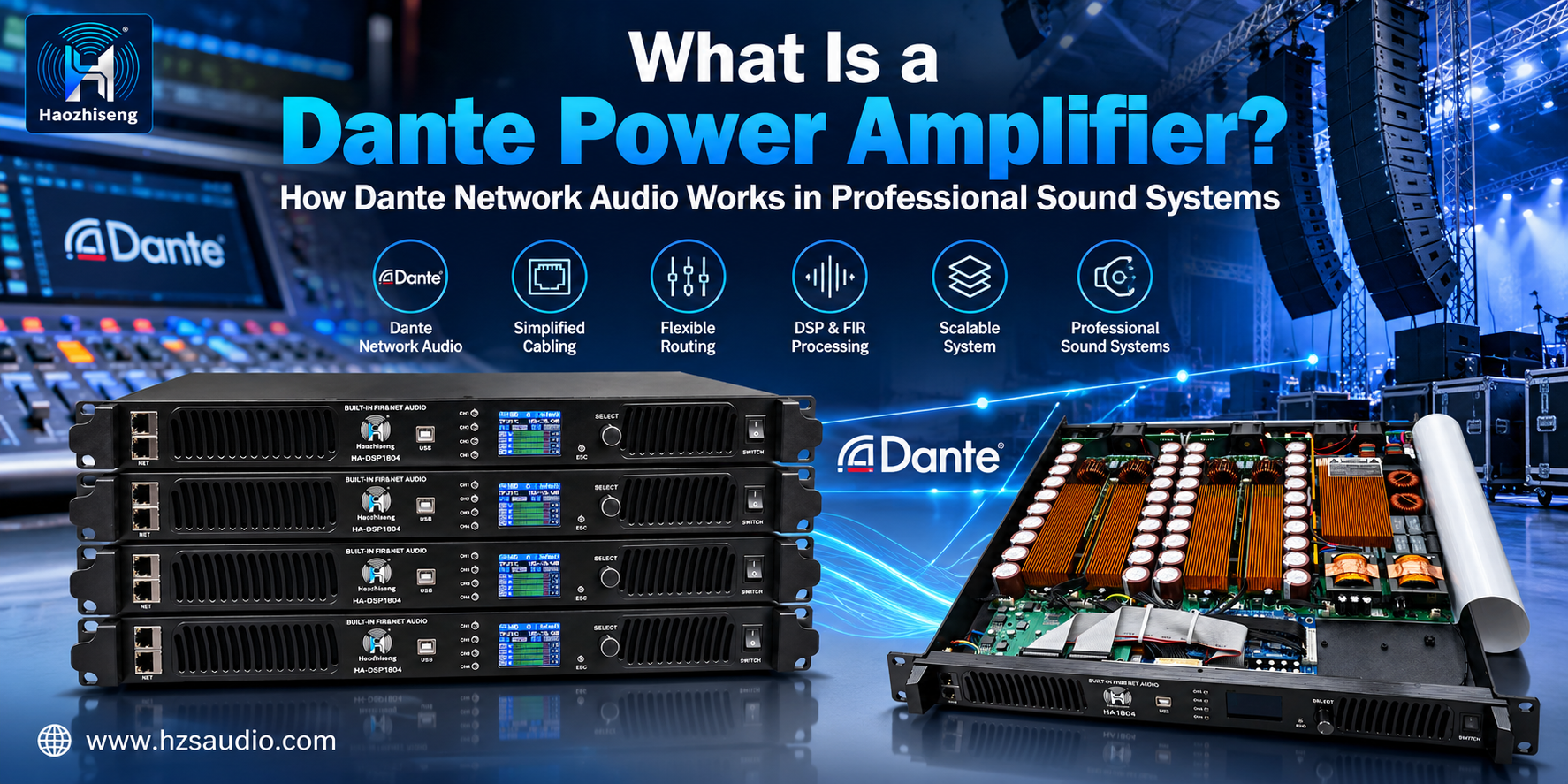
What Is a Dante Power Amplifier? How Dante Network Audio Works in Professional Sound Systems
Professional audio systems are becoming increasingly networked. In large venues, touring systems, houses of worship, theaters, conference centers, and fixed installations, engineers often need to distribute many audio channels across long distances while keeping the system flexible and easy to manage.
This is where Dante network audio becomes especially useful.
Instead of running separate analog audio cables from every signal source to every amplifier, Dante allows multiple channels of digital audio to travel over a standard Ethernet network.
When Dante is integrated directly into a professional DSP power amplifier, the result is a cleaner and more flexible system architecture with digital audio distribution, DSP processing, amplification, and system control working together.
In this guide, we will explain what a Dante power amplifier is, how Dante works, how to connect and configure a Dante audio system, and why Dante-enabled amplifiers are becoming increasingly important in professional sound systems.
What Is Dante Audio?
Dante (Digital Audio Network Through Ethernet) is a network audio technology developed by Audinate.
It allows multiple channels of high-quality digital audio to be transmitted over standard IP networks using Ethernet infrastructure.
In a traditional professional audio system, signals may be distributed using analog XLR cables or other dedicated audio connections.
A Dante system takes a different approach.
Audio devices such as:
- Digital mixing consoles
- DSP processors
- Power amplifiers
- Audio interfaces
- Stage boxes
- Computers
- Network-enabled loudspeaker systems
can communicate through an Ethernet network.
Instead of physically reconnecting multiple audio cables whenever the signal path changes, audio routing can be configured through the Dante network.
This makes Dante particularly attractive for complex professional sound systems.
What Is a Dante Power Amplifier?
A Dante power amplifier is a professional audio amplifier equipped with Dante network audio capability.
A conventional amplifier normally receives analog audio signals through inputs such as XLR connectors.
A Dante-enabled amplifier can receive digital audio directly from a Dante network through its Ethernet connection.
A typical signal path may look like this:
Digital Mixer → Network Switch → Dante Power Amplifier → Loudspeakers
This means the audio signal can remain digital from the mixing console to the amplifier, reducing the need for multiple analog signal connections.
When the amplifier also includes built-in DSP, the system becomes even more powerful.
For example:
Mixer → Dante Network → DSP Processing → Power Amplification → Loudspeaker
The amplifier can receive network audio, process the signal, and drive the loudspeaker from one integrated platform.
How Does Dante Work in a Professional Audio System?
Dante converts digital audio into network data and transmits it through an Ethernet network.
Compatible Dante devices connected to the same network can discover each other and establish audio routes between transmitters and receivers.
For example, imagine a live sound system with a digital mixing console and several Dante DSP power amplifiers.
The system could be configured as:
Digital Mixing Console
↓
Ethernet / Dante Network
↓
Gigabit Network Switch
↓
Dante DSP Power Amplifiers
↓
Line Array Speakers / Subwoofers
One network can therefore distribute audio signals to multiple amplifier channels.
This is especially useful when amplifiers are located in different equipment racks or different areas of a venue.
Dante vs. Traditional Analog Audio
Traditional analog systems remain widely used and can be extremely reliable. However, as system size and channel count increase, network audio can provide significant advantages.
Traditional Analog System
A traditional signal chain may look like:
Mixer → XLR Cable → DSP Processor → XLR Cable → Power Amplifier
Every audio path requires physical connections between devices.
For a small PA system, this is simple and practical.
For a large installation with many amplifier channels, however, cable management can become much more complicated.
Dante Network Audio System
A Dante-based system can simplify the signal path:
Digital Mixer → Ethernet Network → Dante DSP Amplifier
Multiple digital audio channels can be distributed through the network rather than requiring an individual analog cable for every signal path.
This can reduce cabling complexity and make signal routing much more flexible.
Why Use Dante Power Amplifiers?
1. Simplified Audio Cabling
One of the biggest advantages of Dante is the ability to carry multiple audio channels through Ethernet infrastructure.
In larger systems, this can significantly reduce the amount of analog signal cabling required between equipment racks and audio devices.
It can be especially useful for:
- Concert venues
- Stadiums
- Theaters
- Churches
- Conference centers
- Hotels
- Touring systems
- Rental systems
- Large fixed installations
2. Flexible Signal Routing
With traditional analog systems, changing a signal path often means physically reconnecting cables.
With Dante, routing can be configured through the network.
An audio source can be assigned to different Dante receivers without rebuilding the physical signal infrastructure.
This makes system configuration and future expansion much easier.
3. Long-Distance Digital Audio Distribution
Large venues often require audio signals to travel between stages, control rooms, amplifier rooms, and other equipment locations.
Using network infrastructure makes it possible to distribute digital audio across large systems while maintaining an organized architecture.
For permanent installations, existing structured Ethernet infrastructure may also simplify system planning.
4. Scalable System Architecture
One of the strongest advantages of network audio is scalability.
A system can begin with a relatively small number of devices and expand as additional Dante-compatible equipment is added.
This is valuable for venues that may need future expansion.
For example, additional amplifier racks or audio zones can be integrated into the network without completely redesigning the original signal distribution system.
5. Digital Audio from Mixer to Amplifier
In a Dante-based system, the signal can remain digital as it travels from a compatible digital mixing console through the network to the Dante amplifier.
This provides a clean and efficient digital signal path and reduces unnecessary analog signal conversion within the distribution chain.
How to Use Dante with a Professional Power Amplifier
The exact configuration depends on the equipment being used, but a typical Dante amplifier setup follows several basic steps.
Step 1: Connect the Dante Devices
Connect your Dante-enabled equipment to a compatible Ethernet network.
A basic system might include:
Dante Digital Mixer → Gigabit Network Switch → Dante Power Amplifier
Use appropriate network cables and professional networking equipment suitable for the installation.
Step 2: Connect Your Computer to the Network
Connect a computer running the required Dante configuration software to the same network.
The computer can then discover compatible Dante devices connected to the network.
Step 3: Check Device Names and Network Status
Before routing audio, confirm that the Dante devices are correctly detected.
It is good practice to give devices clear names, particularly in large systems.
For example:
- MAIN-AMP-L
- MAIN-AMP-R
- SUB-AMP-01
- FRONT-FILL
- DELAY-TOWER
Clear naming makes troubleshooting and system management much easier.
Step 4: Route Dante Audio Channels
Select the transmitting device and assign its audio channels to the required amplifier inputs.
For example:
Mixer Output 1 → Amplifier Channel 1
Mixer Output 2 → Amplifier Channel 2
Mixer Output 3 → Amplifier Channel 3
Mixer Output 4 → Amplifier Channel 4
Once the routing is configured correctly, the amplifier can receive digital audio directly from the Dante network.
Step 5: Configure the Amplifier DSP
If your Dante amplifier includes built-in DSP, the next step is loudspeaker processing.
Depending on the amplifier, DSP functions may include:
- Input and output routing
- Gain
- Mute
- Polarity
- PEQ
- Crossover
- Delay
- Limiter
- Matrix mixing
- FIR filtering
Correct DSP configuration is extremely important because the amplifier must be matched to the loudspeaker system.
Step 6: Set Loudspeaker Protection
Before operating the system at high output levels, configure appropriate limiter and crossover settings according to the loudspeaker specifications.
This helps protect LF and HF drivers from excessive power or inappropriate frequency content.
For professional installations, amplifier presets can also be prepared for specific loudspeaker models.
Step 7: Test the Complete Signal Chain
Start with a low output level.
Verify:
Source → Dante Network → Amplifier Input → DSP → Amplifier Output → Loudspeaker
Check each channel individually before operating the system at normal levels.
Also confirm correct polarity, routing, crossover settings, delay, gain structure, and limiter configuration.
Dante + DSP + FIR: A Powerful Combination
Modern professional amplifiers increasingly combine several technologies in one device:
Dante + DSP + FIR + Power Amplification
This creates a highly integrated system.
Dante handles digital audio distribution.
DSP handles loudspeaker management.
FIR processing can provide more advanced loudspeaker correction and system optimization.
The power amplifier then delivers the required output to the loudspeakers.
Instead of using multiple independent devices, engineers can build a more integrated signal chain.
What Is FIR Processing?
FIR stands for Finite Impulse Response.
In professional loudspeaker processing, FIR filters can be used for advanced frequency and phase optimization.
Compared with basic EQ and crossover processing, FIR provides system designers with additional tools for precise loudspeaker correction.
Depending on the loudspeaker design and measurement data, FIR processing can be used as part of:
- Frequency-response optimization
- Phase-response correction
- Loudspeaker preset development
- System alignment
- Crossover optimization
When combined with Dante network audio, FIR-capable DSP amplifiers provide both flexible audio distribution and advanced loudspeaker processing.
Where Are Dante Power Amplifiers Used?
Dante amplifiers are especially useful in professional systems where multiple audio channels must be distributed efficiently.
Typical applications include:
Live Concerts and Touring
Network audio can simplify connections between FOH, stage equipment, processing racks, and amplifier racks.
Houses of Worship
Church sound systems may include main arrays, subwoofers, front fills, delay speakers, monitors, and distributed audio zones.
Dante makes these systems easier to route and expand.
Theaters and Performing Arts Centers
Complex productions often require many audio channels and multiple speaker zones.
Network audio provides flexible signal distribution between different parts of the venue.
Stadiums and Large Venues
Large installations can involve amplifier rooms located far from the main control position.
Dante provides an efficient solution for distributing audio across these systems.
Rental Companies
Rental systems frequently change configuration depending on the event.
Network routing allows technicians to adapt signal distribution without rebuilding every analog connection.
Fixed Installations
Hotels, conference centers, clubs, entertainment venues, and multipurpose halls can benefit from centralized network audio management.
Haozhiseng Audio Dante DSP Power Amplifier Solutions
At Haozhiseng Audio, we develop professional power amplifiers and DSP solutions for touring, rental, live sound, and fixed installation applications.
Several of our professional amplifier platforms combine high-power Class D amplification with advanced DSP and Dante network audio.
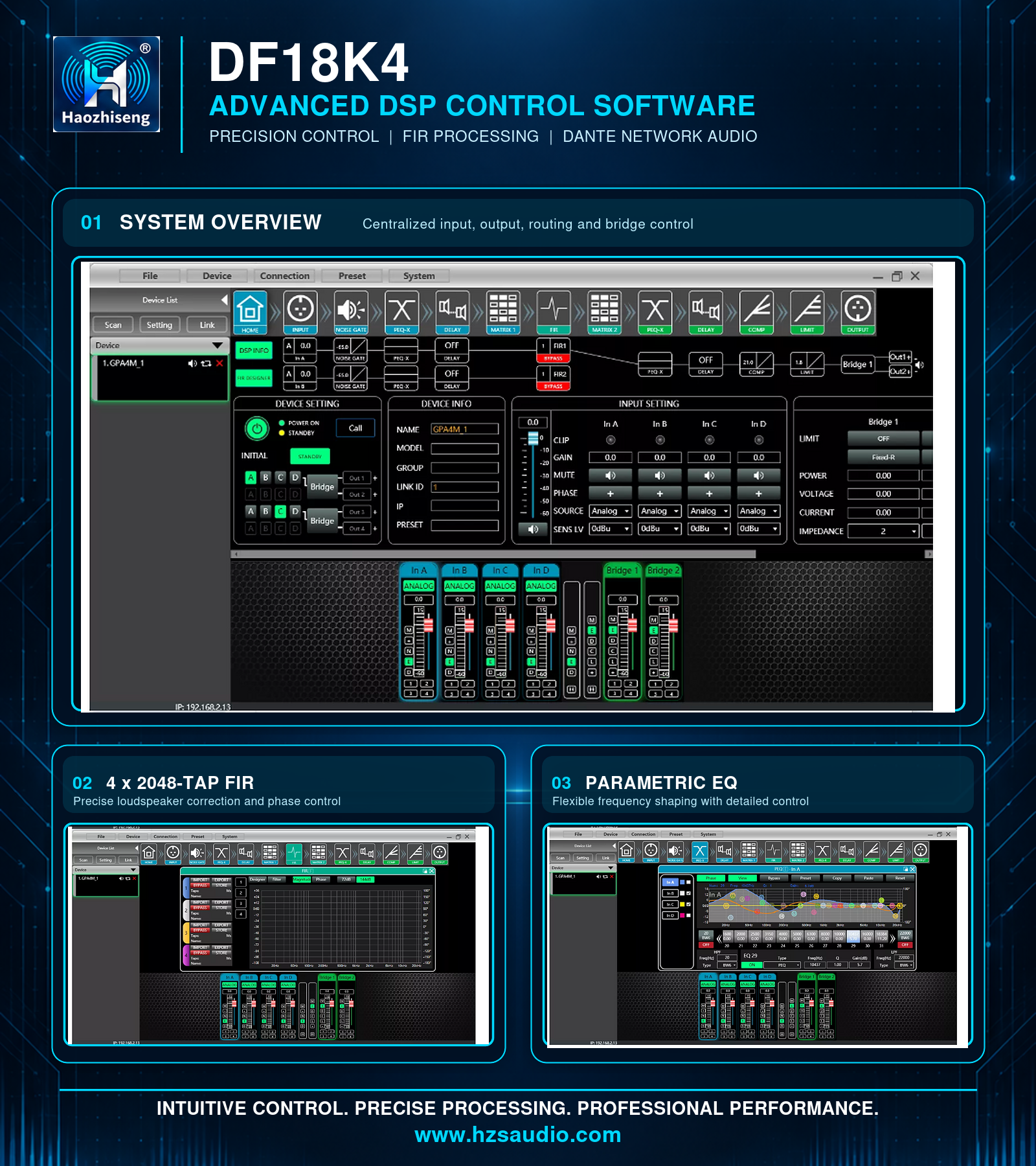
DF18K4 18,000W 4-Channel DSP Power Amplifier
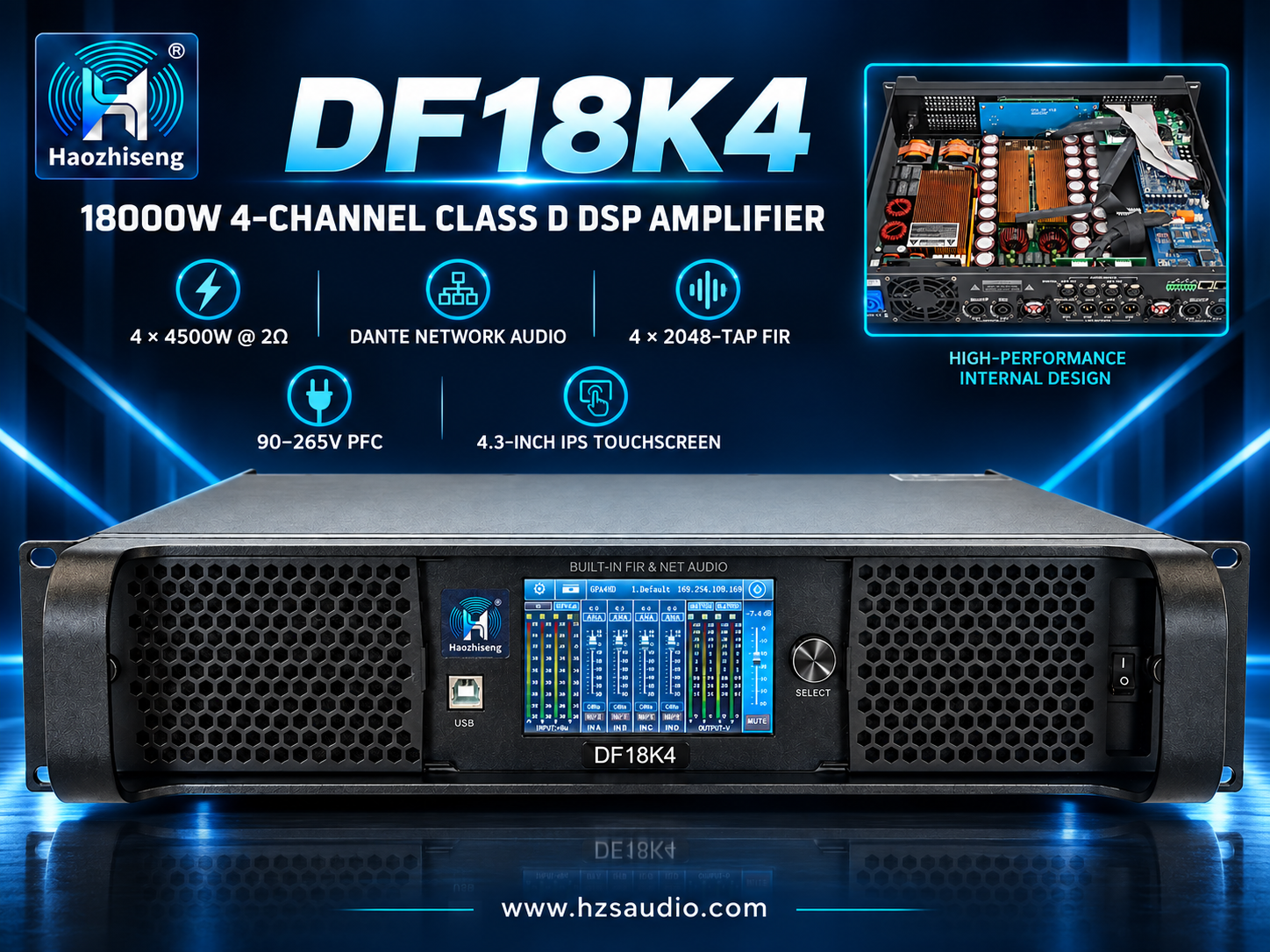
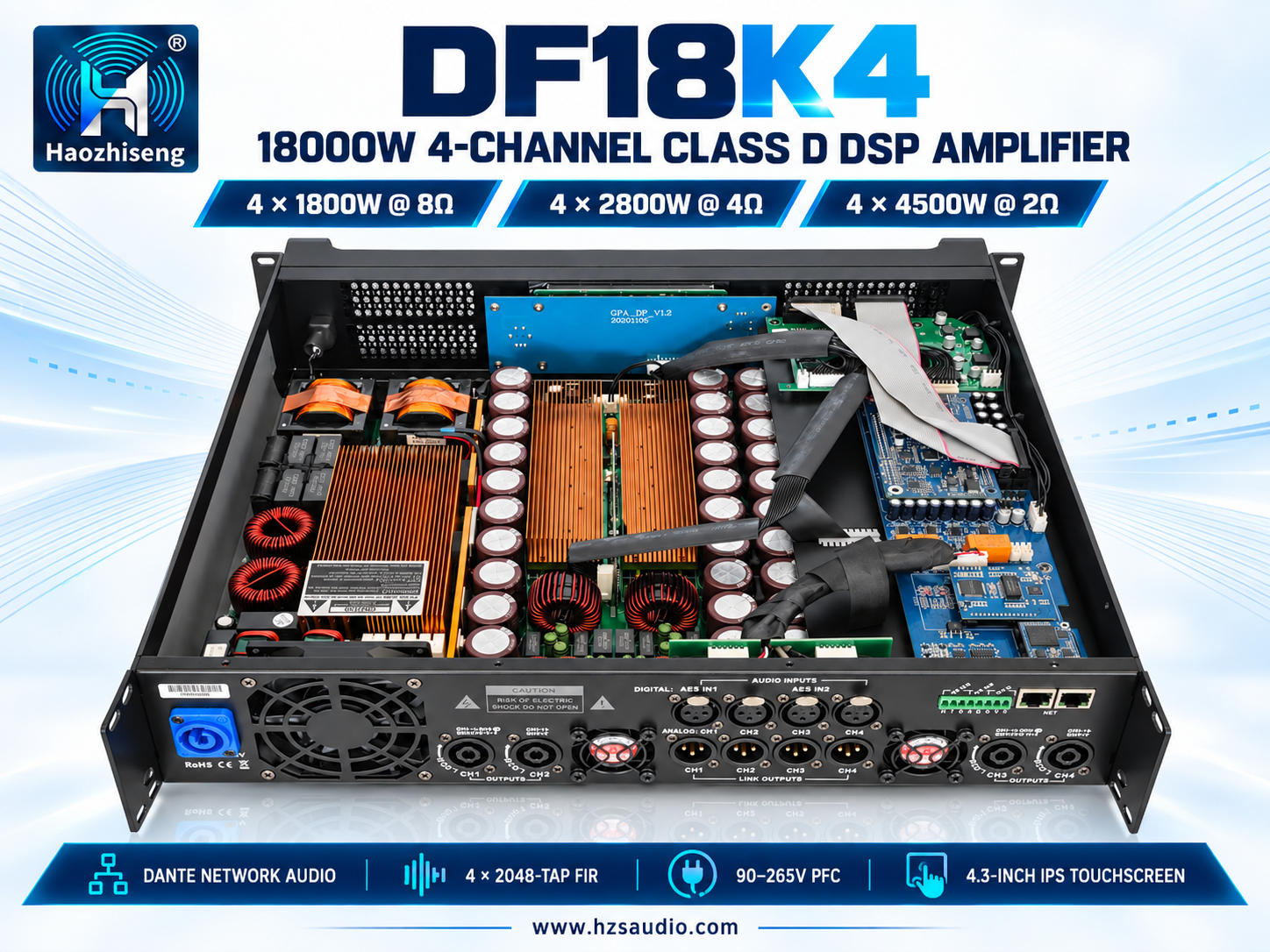
The DF18K4 is a high-output 4-channel Class D DSP amplifier designed for demanding professional sound systems.
Key Features
- Maximum combined output power: 18,000W
- 4 × 1800W at 8Ω
- 4 × 2800W at 4Ω
- 4 × 4500W at 2Ω
- 2 × 5600W bridged at 8Ω
- 2 × 9000W bridged at 4Ω
- Stable 2Ω operation
- Integrated Dante network audio
- 4 × 2048-tap FIR filters
- PEQ, crossover, delay, limiter and mixer
- 4.3-inch IPS touchscreen
- USB and network DSP control
- 90–265V AC wide-voltage PFC power supply
- Compact 2U rack-mount design
The combination of high output power, Dante networking, FIR processing, DSP control, and wide-voltage PFC makes the DF18K4 suitable for line arrays, high-output subwoofers, touring systems, rental companies, and large fixed installations.
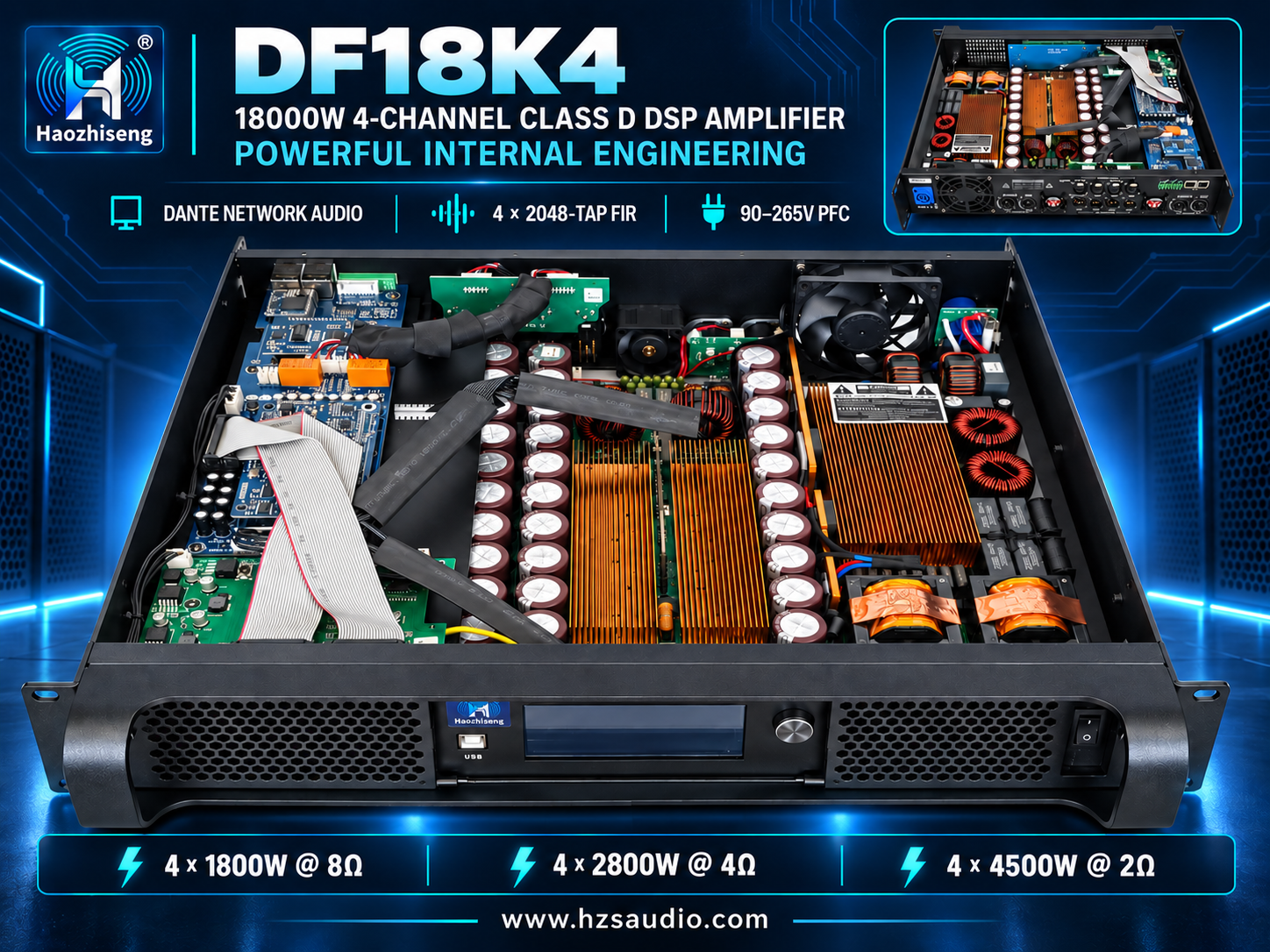
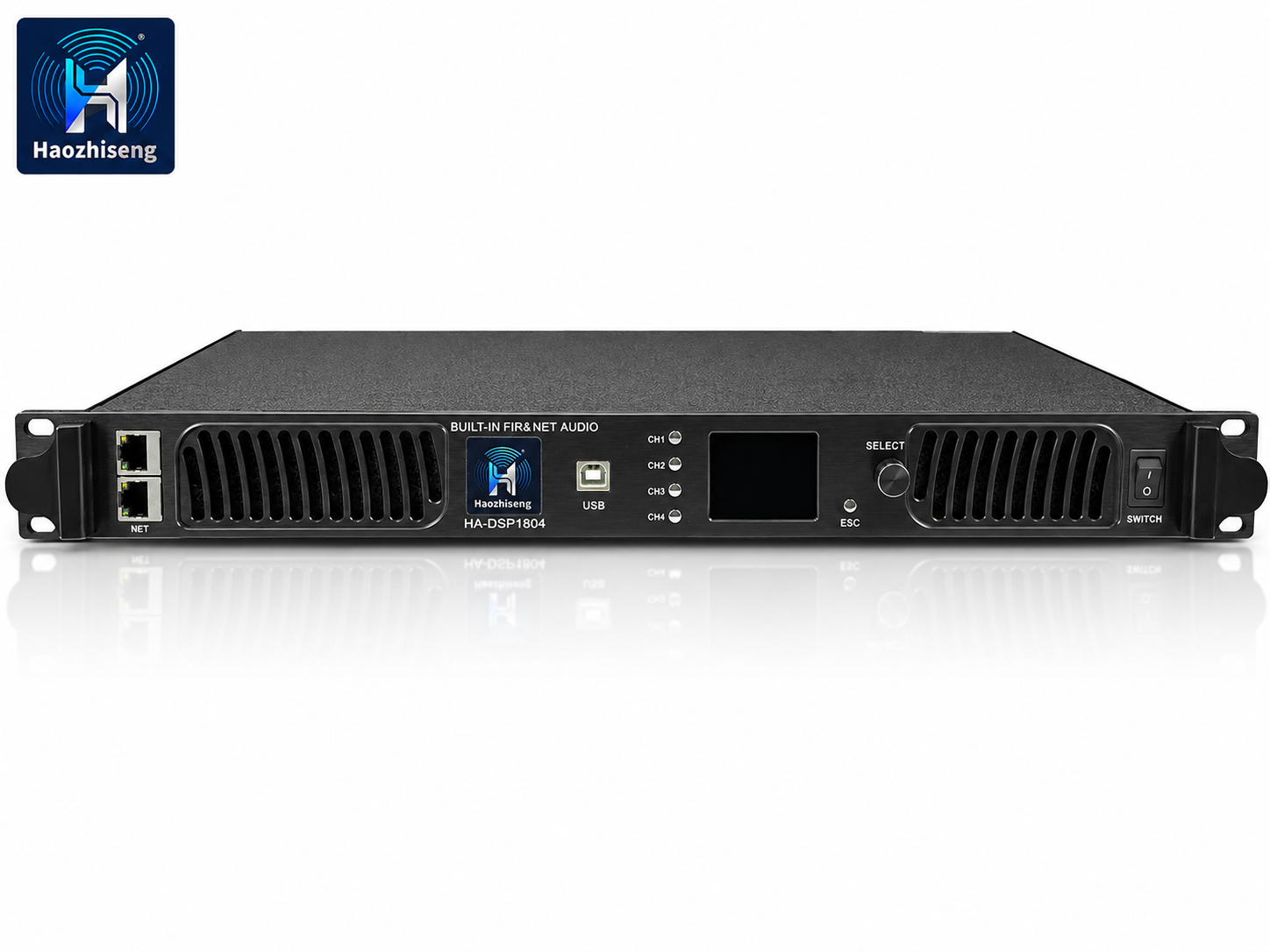
HA-DSP1804 Professional Dante DSP Power Amplifier

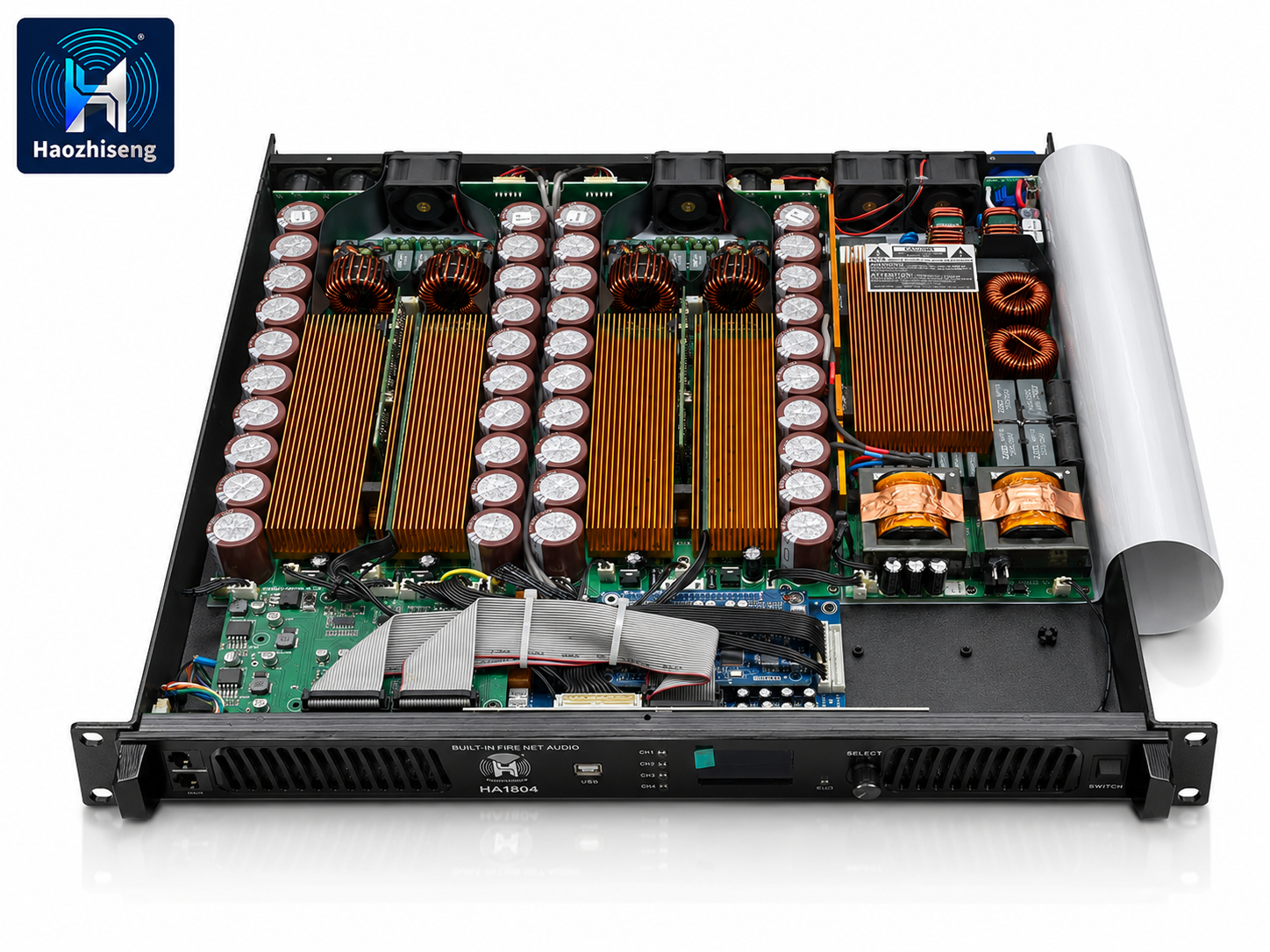
The HA-DSP1804 combines high-output amplification with professional DSP processing and Dante network audio.
Output Power
- 4 × 1800W at 8Ω
- 4 × 2800W at 4Ω
- 4 × 4500W at 2Ω
Its DSP platform provides professional loudspeaker management functions including:
- FIR processing with 4 × 2048 taps
- PEQ
- Crossover
- Delay
- Limiter
- Mixer
- Gain
- Polarity
- Mute
- ALLPASS processing
The amplifier also features a 90–260V wide-voltage PFC power supply, making it suitable for professional systems operating in different regions and demanding power environments.
With Dante network audio integrated into the amplifier, the HA-DSP1804 can become part of a complete digital audio network from the mixing console to the loudspeaker system.

Is Dante Better Than Analog Audio?
Dante should not simply be considered a replacement for analog audio.
Both technologies have appropriate applications.
For a small sound system with only a few channels, conventional analog connections may be simple, cost-effective, and reliable.
As the number of channels, amplifier racks, audio zones, and equipment locations increases, however, Dante can provide major advantages in routing flexibility, cabling, scalability, and system management.
The right choice depends on the size and requirements of the project.
For many modern professional sound systems, a hybrid architecture using both Dante and analog connections can also provide excellent flexibility and redundancy.
Do You Need a Special Network Switch for Dante?
Dante operates over standard IP networking technology, but network design is still extremely important in professional audio applications.
For reliable performance, the network infrastructure should be selected and configured according to the size and requirements of the Dante system.
For larger installations, system designers should carefully consider:
- Network bandwidth
- Switch capacity
- Network topology
- Latency requirements
- Device count
- Redundancy
- Quality of Service
- Other network traffic
A properly designed audio network is just as important as choosing the correct amplifier and loudspeaker.
Final Thoughts
Professional audio is moving toward increasingly integrated and networked system architectures.
A Dante power amplifier combines network audio distribution with professional amplification, while a Dante DSP power amplifier goes even further by integrating loudspeaker processing and system control into the same platform.
For sound engineers, rental companies, system integrators, and installation contractors, this can mean:
- Fewer analog signal cables
- More flexible audio routing
- Easier system expansion
- Centralized DSP control
- A cleaner digital audio workflow
When technologies such as Dante, DSP, FIR processing, high-power Class D amplification, and PFC power supplies are combined, professional sound systems can become more powerful, flexible, and easier to manage.
Whether you are designing a line array system for touring, upgrading a house of worship, building a nightclub sound system, or planning a large fixed installation, Dante-enabled DSP amplifiers provide a modern platform for professional audio distribution and loudspeaker management.
Recommended Dante DSP Amplifiers for Professional Audio Systems
If you are planning to build or upgrade a professional Dante audio system, choosing the right DSP power amplifier is an important part of the system design.
For applications requiring high output power, Dante network audio, FIR processing, advanced DSP control, and stable low-impedance operation, we recommend exploring Haozhiseng Audio Dante DSP power amplifier solutions, including the DF18K4 and HA-DSP1804.
These amplifiers are designed for applications such as:
- Professional line array systems
- High-power subwoofer systems
- Concert and touring sound
- Rental sound systems
- Houses of worship
- Nightclubs and entertainment venues
- Theaters and auditoriums
- Large fixed installations
If you are unsure which amplifier is suitable for your loudspeakers, our team can also help you select the appropriate amplifier power, DSP configuration, FIR settings, and complete system solution according to your project requirements.
Need Help with Your Next Professional Audio Project?
Every sound system is different.
Whether you need a Dante DSP amplifier for a single loudspeaker system or are designing a complete professional audio solution with multiple amplifiers, line arrays, subwoofers, and DSP processing, Haozhiseng Audio is ready to support your project.
Contact us to discuss your system requirements and find the right professional audio solution.
Share This Guide with the Professional Audio Community
Did you find this guide useful?
If so, please share it with sound engineers, audio technicians, system integrators, installers, rental companies, distributors, and other professional audio users who may want to learn more about Dante network audio and DSP power amplifiers.
Dante is changing the way modern professional audio systems are connected, routed, processed, and managed. By sharing practical knowledge and real-world experience, we can help more audio professionals build simpler, smarter, more flexible, and more reliable sound systems.
If you know someone who is planning a new sound system, upgrading an amplifier rack, or learning how to integrate Dante into a professional audio system, share this article with them.
Your support, recommendations, and shares help us continue creating more professional audio guides, DSP tutorials, product testing, application solutions, and technical content for the global pro audio community.
Thank you for reading and supporting Haozhiseng Audio.
Better Sound. Smarter Systems. Share the Knowledge.
Frequently Asked Questions
What is a Dante power amplifier?
A Dante power amplifier is a professional amplifier capable of receiving digital audio through a Dante Ethernet network. This allows audio signals to be routed from compatible mixers, processors, and other Dante devices directly to the amplifier through network infrastructure.
Does Dante replace XLR cables?
Dante can significantly reduce the number of analog audio cables required in larger systems, but analog connections remain useful for many applications, including backup signal paths and smaller systems.
Can multiple amplifiers use the same Dante network?
Yes. Multiple compatible Dante devices can operate on the same properly designed network, allowing audio channels to be routed to different amplifier inputs and system zones.
Why combine Dante with DSP?
Dante manages network audio distribution, while DSP provides loudspeaker processing such as EQ, crossover, delay, limiting, routing, and FIR filtering. Combining both technologies in a power amplifier creates a more integrated professional audio system.
What systems are suitable for Dante amplifiers?
Dante amplifiers are well suited for line array systems, touring sound, concerts, houses of worship, theaters, stadiums, clubs, rental systems, conference centers, and large fixed installations.
Leave a Reply