

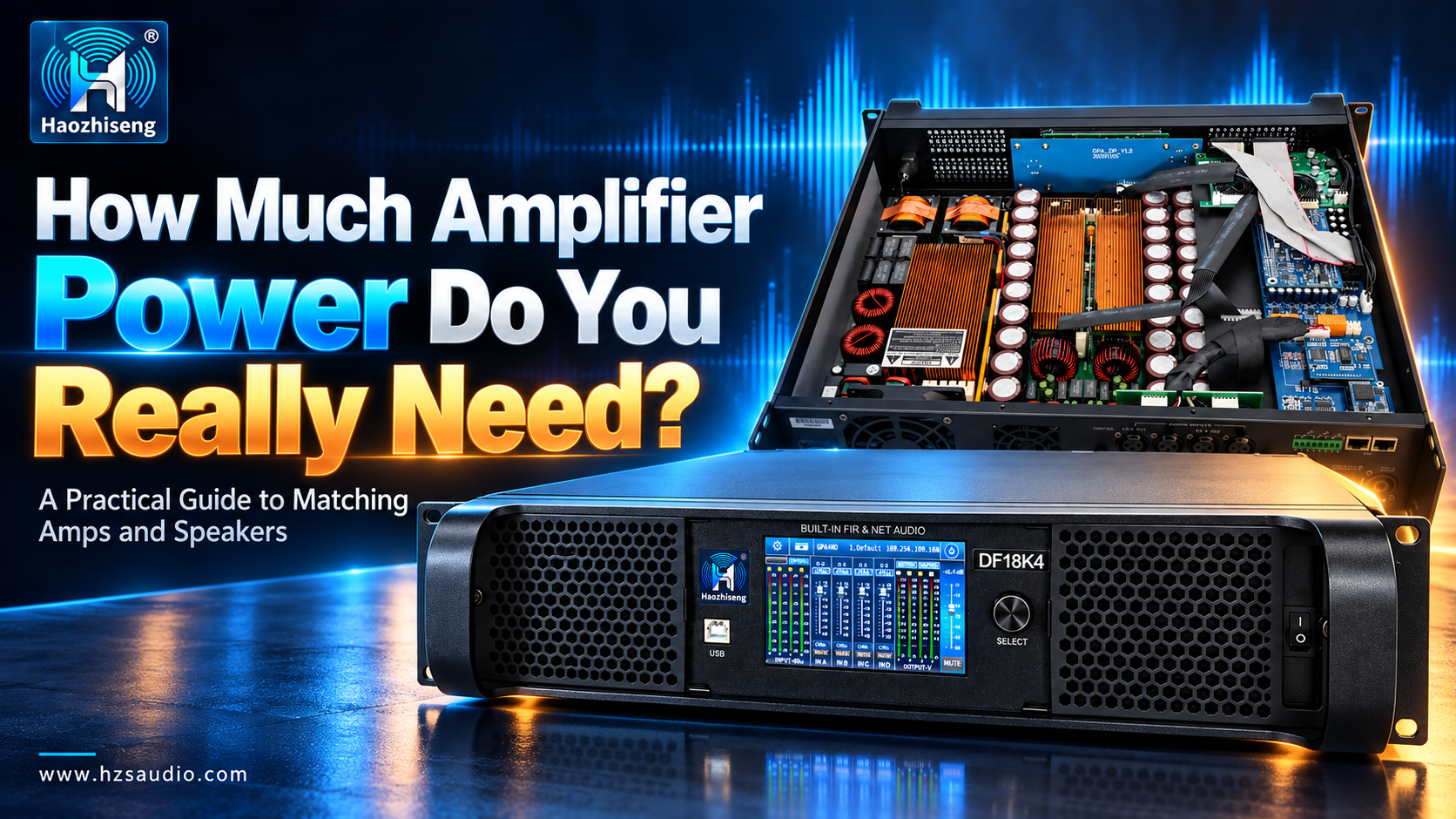
How Much Amplifier Power Do You Really Need? A Practical Guide to Matching Amps and Speakers
Choosing a power amplifier can seem straightforward: check the speaker’s wattage, find an amplifier with enough power, and connect the system.
In practice, a successful match depends on more than watts.
Loudspeaker impedance, sensitivity, listening distance, program material, and DSP settings all affect how much amplifier power you need—and how effectively you can use it.
Whether you are building a church PA system, upgrading a DJ setup, or designing a touring subwoofer rack, this guide explains the key decisions and introduces suitable amplifier options from Haozhiseng Audio.
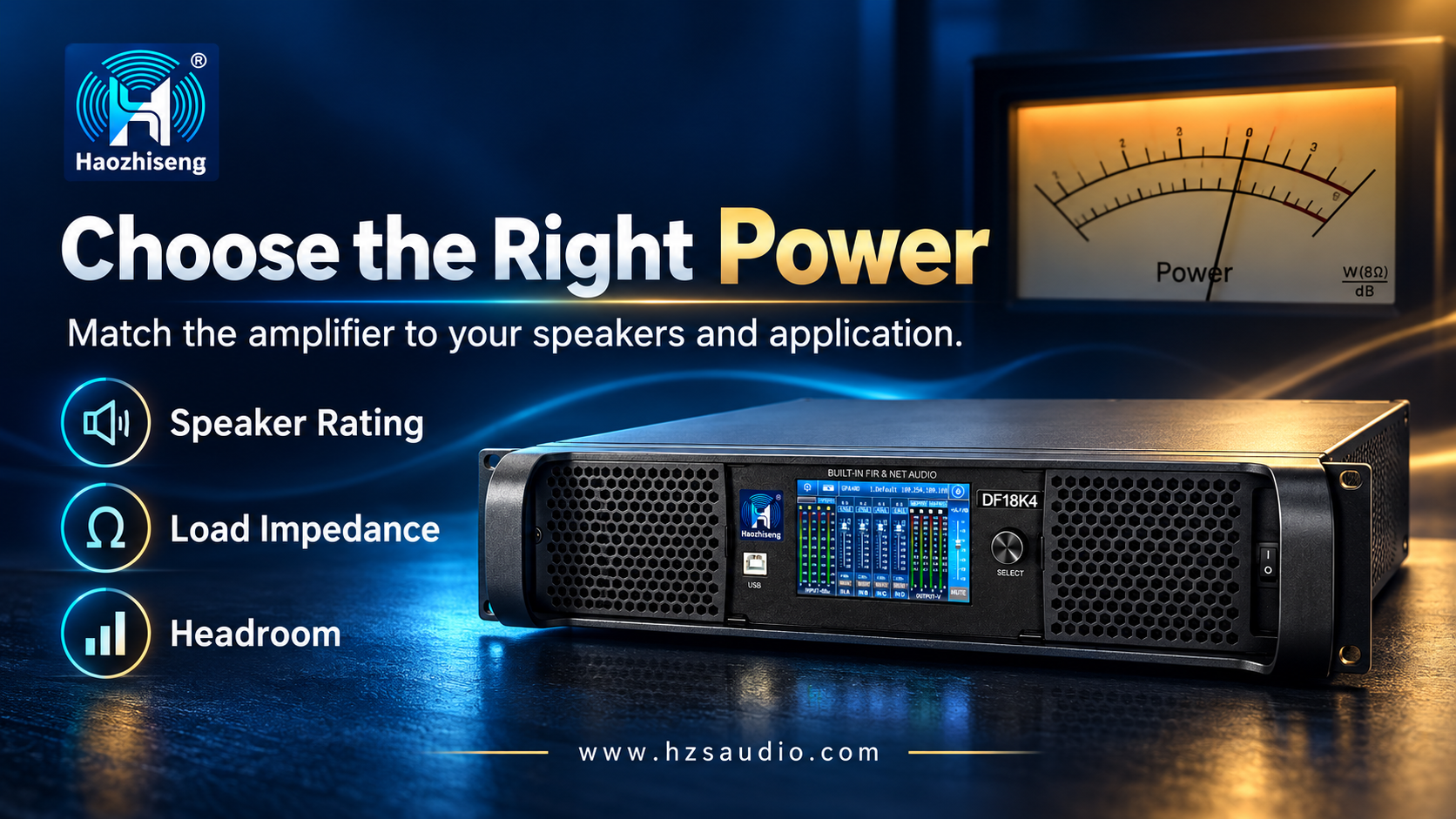
1. Understand Your Speaker’s Power Rating
Start with the loudspeaker manufacturer’s specifications. Continuous, program, and peak ratings describe different operating conditions.
| Power Rating | What It Means for Amplifier Selection |
|---|---|
| Continuous / AES / IEC | Power handling under defined test conditions. Check the standard, bandwidth, and test duration. |
| Program | A manufacturer-defined rating intended to represent musical use. Its relationship to continuous power varies. |
| Peak | Short-duration capability, not a level the loudspeaker can sustain continuously. |
“RMS power” is often used as shorthand for continuous power handling, but the label alone does not establish how a product was tested.
A loudspeaker advertised as “2,000W peak” should not automatically be matched to an amplifier delivering 2,000W continuously.
Use the manufacturer’s recommended amplifier range and processing settings whenever available.
2. Allow Headroom for Musical Peaks
Music does not demand the same output level all the time. Drum hits and other transients can rise well above the average signal level.
Amplifier headroom provides room for these short peaks before clipping occurs.
A commonly used starting point for professional live sound is an amplifier rated around twice the loudspeaker’s continuous power handling at the same nominal impedance. This is a selection guideline, not a universal rule or permission to exceed the speaker’s limits.
For example:
| Item | Example |
|---|---|
| Loudspeaker | 500W continuous, 8Ω |
| Amplifier to evaluate | Approximately 1,000W per channel at 8Ω |
| Intended benefit | Additional capacity for short musical peaks |
| Required setup | Appropriate filtering, limiting, and operating levels |
An amplifier capable of 1,000W does not mean the speaker should receive 1,000W continuously.
Background music, heavily compressed DJ tracks, and individual high-frequency drivers may require different selection and protection strategies. Always prioritize the loudspeaker manufacturer’s guidance.
3. Compare Output at the Correct Impedance
Amplifier power ratings depend on the connected load.
An amplifier rated at 1,000W per channel into 4Ω will not necessarily deliver that power into an 8Ω loudspeaker. Compare specifications at the load your system will actually present.
For identical 8Ω cabinets connected in parallel:
| Cabinets per Channel | Combined Nominal Impedance |
|---|---|
| One | 8Ω |
| Two | 4Ω |
| Four | 2Ω |
For example, two identical 8Ω cabinets connected in parallel create a nominal 4Ω load. If the amplifier delivers 2,000W into that load, the cabinets share approximately 1,000W each under comparable conditions.
Before connecting multiple cabinets, check the amplifier’s minimum permitted impedance, the selected operating mode, and the loudspeakers’ combined requirements.
Nominal impedance is a simplified rating. Actual loudspeaker impedance changes with frequency, so current delivery and load stability also matter.
4. More Power Does Not Mean Proportionally More Volume
Under ideal conditions, doubling electrical power increases SPL by approximately 3 dB, provided the loudspeaker remains within its linear operating range.
| Power Change | Approximate SPL Increase |
|---|---|
| 250W to 500W | +3 dB |
| 500W to 1,000W | +3 dB |
| 250W to 1,000W | +6 dB |
A more powerful amplifier therefore produces a smaller increase in volume than many buyers expect.
Speaker sensitivity is equally relevant. Under equivalent measurement conditions, a speaker with 3 dB higher sensitivity requires approximately half the power to produce the same SPL.
Check whether sensitivity is measured at 1W/1m or 2.83V/1m before comparing products. These measurements are not equivalent at every impedance.
At high levels, power compression and excursion limits can further reduce the benefit of additional amplifier power.
5. Consider Distance, Coverage, and the Venue
A system that sounds loud near the stage may not provide adequate coverage at the back of a room.
For a simplified point source in free-field conditions, doubling listening distance reduces SPL by approximately 6 dB. Real venues, line arrays, boundaries, and reflections change this behavior.
Amplifier selection should therefore consider:
- Required listening level
- Distance to the audience
- Loudspeaker sensitivity and maximum SPL
- Coverage pattern and placement
- Headroom for the program material
These factors also appear in published amplifier-sizing guidance.
If coverage is uneven, improving loudspeaker placement or adding appropriately aligned fill speakers may be more effective than simply increasing amplifier power.
6. Choose Subwoofer Amplifiers Carefully
Subwoofers can place demanding loads on amplifiers, particularly with sustained bass-heavy music.
When evaluating an amplifier for passive subwoofers, consider:
- Output capability at the intended impedance
- Sustained performance and short-burst capability
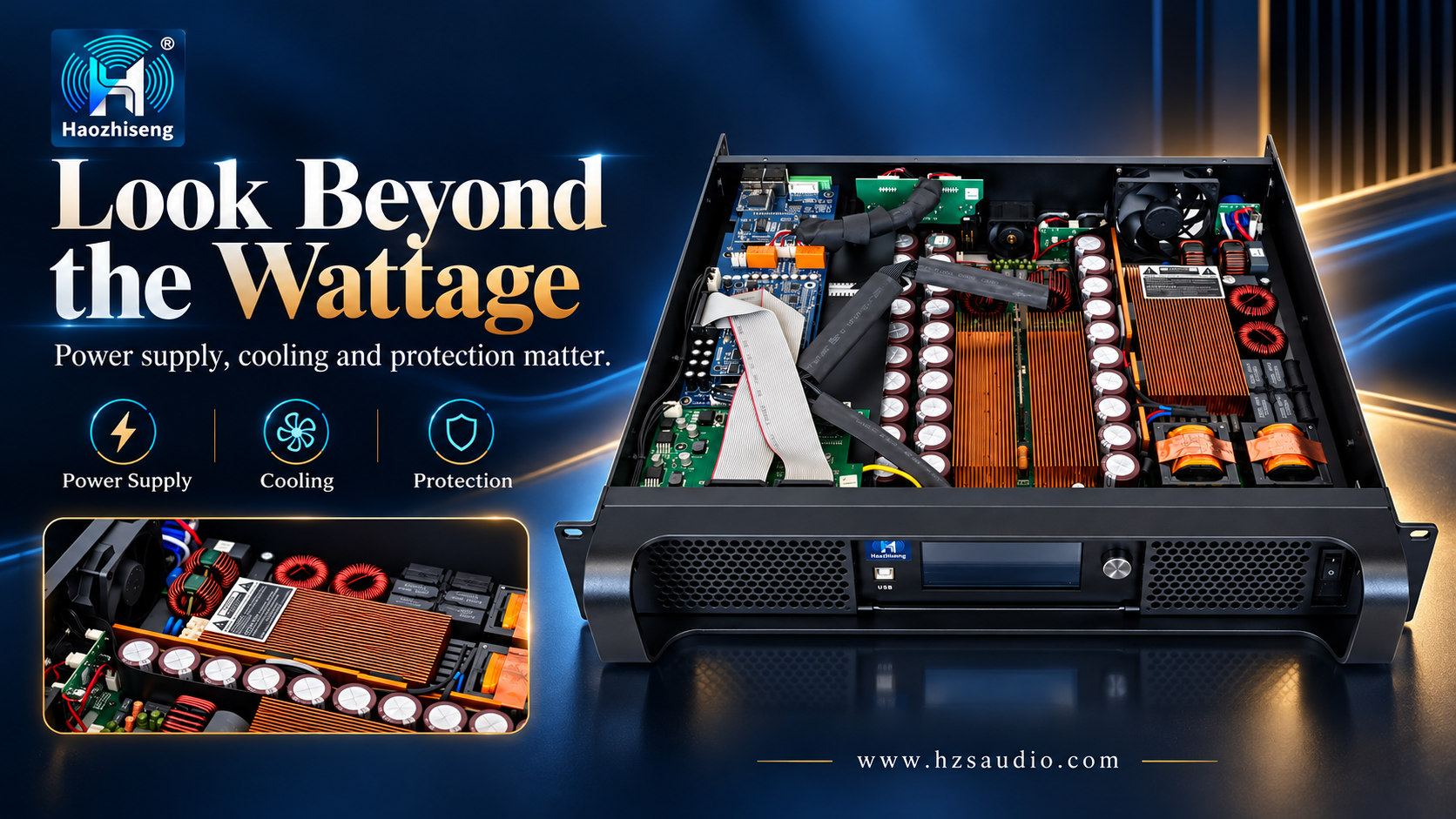
- Cooling and available AC power
- Crossover and high-pass filter settings
- Peak and long-term limiting
- Loudspeaker excursion and thermal limits
Burst and continuous amplifier ratings describe different capabilities. Compare their measurement conditions rather than assuming every advertised wattage represents the same kind of output.
A suitable high-pass filter helps reduce energy below the subwoofer’s intended operating range. Additional amplifier power cannot overcome an enclosure’s acoustic limitations or a driver’s excursion limits.
7. Avoid Clipping and Excessive Output
A smaller amplifier does not damage a speaker merely because it has a lower power rating.
Problems can arise when the system is pushed beyond its available output and driven into sustained clipping. Heavy clipping can increase average power and alter the signal’s spectral content, placing additional stress on loudspeaker components.
A larger amplifier can also damage speakers if it delivers excessive voltage, sustained power, or low-frequency excursion.
The goal is to provide sufficient output capacity and control it correctly.
Avoid persistent clipping, use appropriate processing, and monitor system behavior. An amplifier gain knob is not a calibrated power limiter: setting it halfway does not establish a fixed half-power maximum.
8. Use DSP to Manage the Available Power
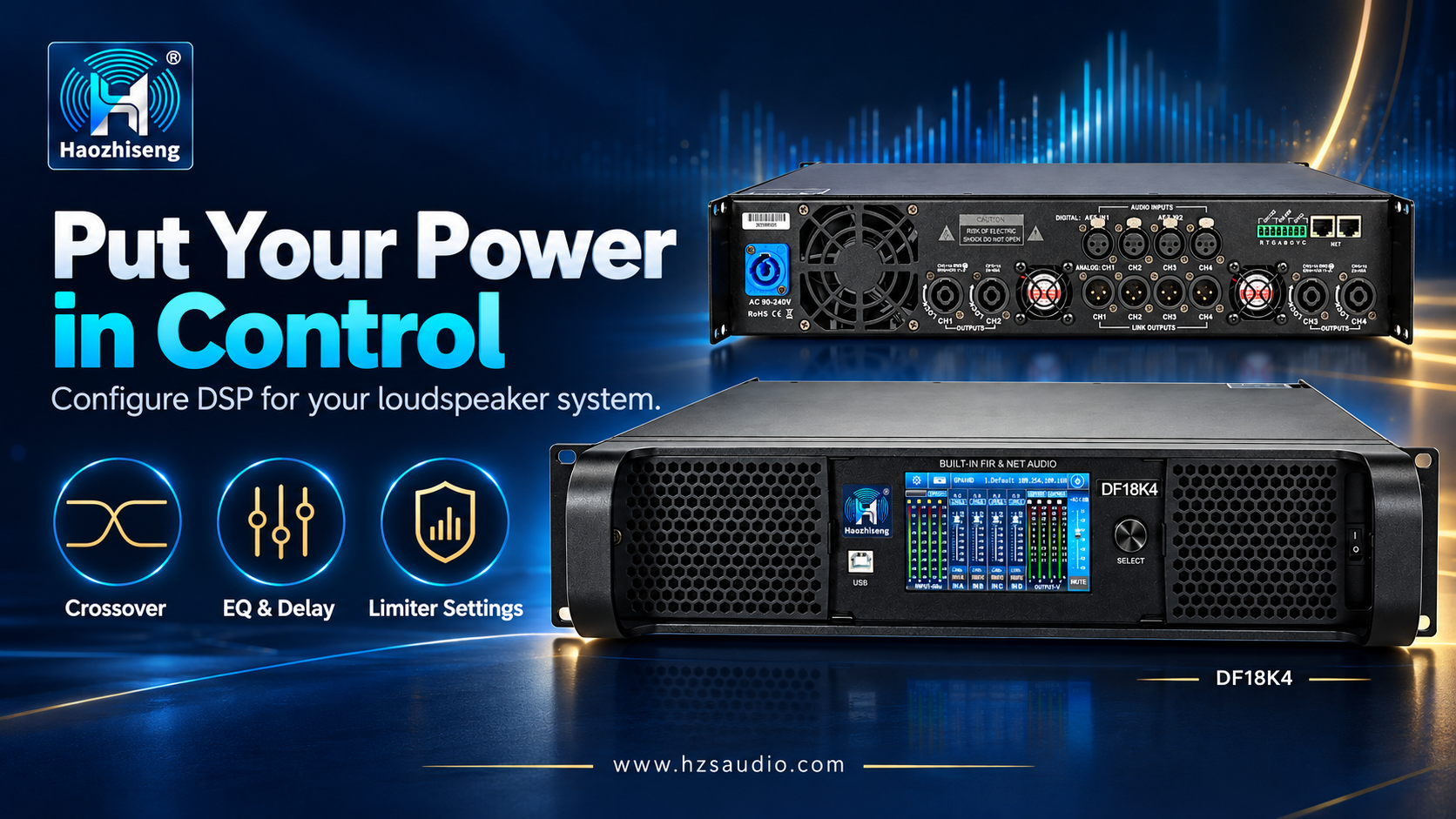
DSP helps adapt an amplifier to the connected loudspeakers.
| Function | Main Purpose |
|---|---|
| High-pass filter | Reduces energy below the loudspeaker’s intended operating range |
| Crossover | Assigns suitable frequency bands to different drivers or cabinets |
| Peak limiter | Helps control short-duration output peaks |
| RMS / long-term limiter | Helps manage sustained signal level and thermal stress |
| EQ | Adjusts tonal balance; boosts also increase output demand |
| Delay and polarity | Support alignment between loudspeaker sections |
| FIR filtering | Enables additional frequency and phase-response adjustment when supported |
Limiter thresholds must account for amplifier gain, processor calibration, loudspeaker limits, and timing behavior.
Use verified manufacturer presets where available. Copying limiter settings from an unrelated system may provide unsuitable protection.
9. Understand Bridged Operation
Bridge mode combines two amplifier channels to increase the voltage available across a compatible load.
The minimum permitted bridged load is often higher than the minimum stereo load. A 4Ω bridged load places approximately the same current demand on each channel as a 2Ω load in stereo operation.
Do not assume an amplifier supporting 2Ω stereo also supports 2Ω bridged operation.
Follow the amplifier’s bridge-mode wiring instructions and published load limits. Separate channels may be preferable when you need independent processing, level control, or fault isolation.
10. Prepare a Simple Amplifier-Matching Checklist
Before choosing a model, gather:
- Speaker specifications: Model, continuous power handling, and recommended amplifier range.
- Impedance: The combined nominal load on each channel.
- Cabinet quantity: How many loudspeakers each channel will drive.
- Application: Speech, live music, background music, or bass-heavy playback.
- Coverage requirements: Venue layout, listening distance, and target output.
- Processing needs: External DSP or integrated processing.
- Installation requirements: Mains supply, cooling, rack space, and transport weight.
With this information, you can compare amplifiers according to the system’s actual requirements.
11. Recommended Haozhiseng Audio Amplifiers
The following models provide options for compact racks, integrated DSP systems, and demanding subwoofer applications.
The suggested uses below are starting points based on their published features. Final selection depends on your loudspeaker loads, required output, and processing configuration.
Compact Amplifiers for Portable and Touring Systems
HA1804 — Four Channels in a Compact 1U Chassis
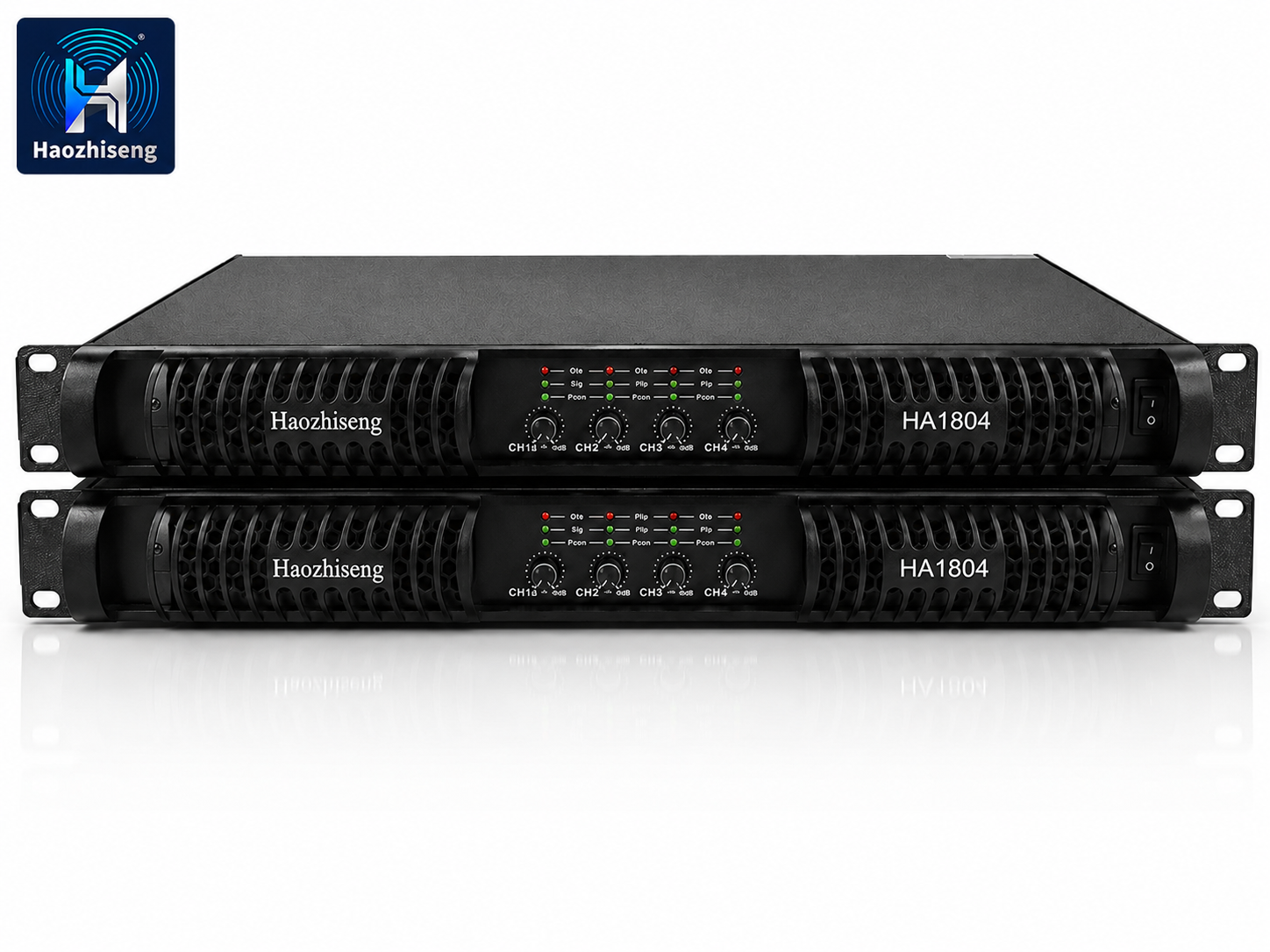

The HA1804 offers:
- 4 × 1800W at 8Ω
- 4 × 2800W at 4Ω
- 4 × 4500W at 2Ω
- 1U rackmount design
- 90–260V PFC power supply
Consider the HA1804 when you need four amplifier channels in a compact rack, particularly for portable PA systems and installations using external loudspeaker processing.
HA2402 — Two Channels for Dedicated Subwoofer Feeds
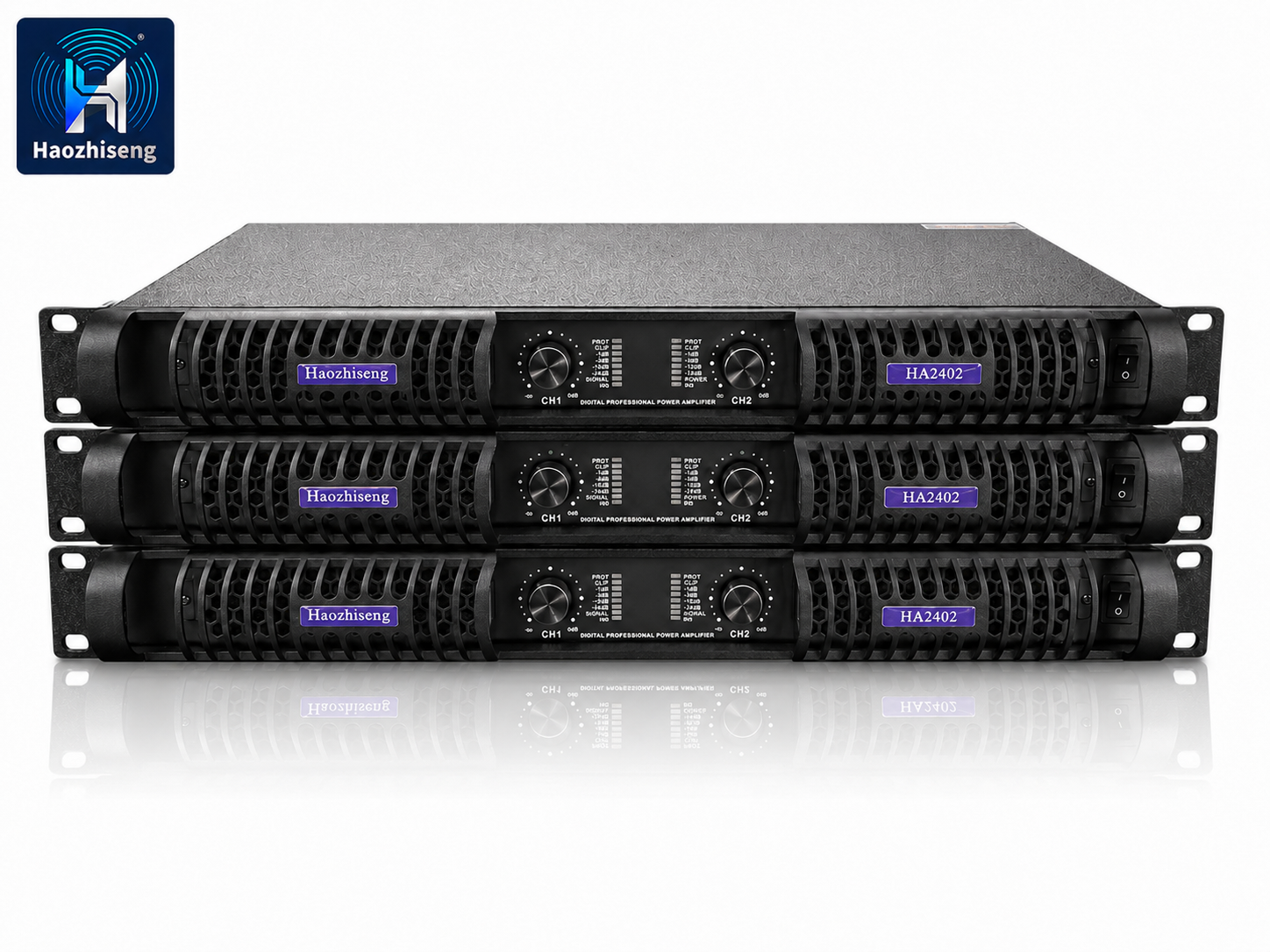
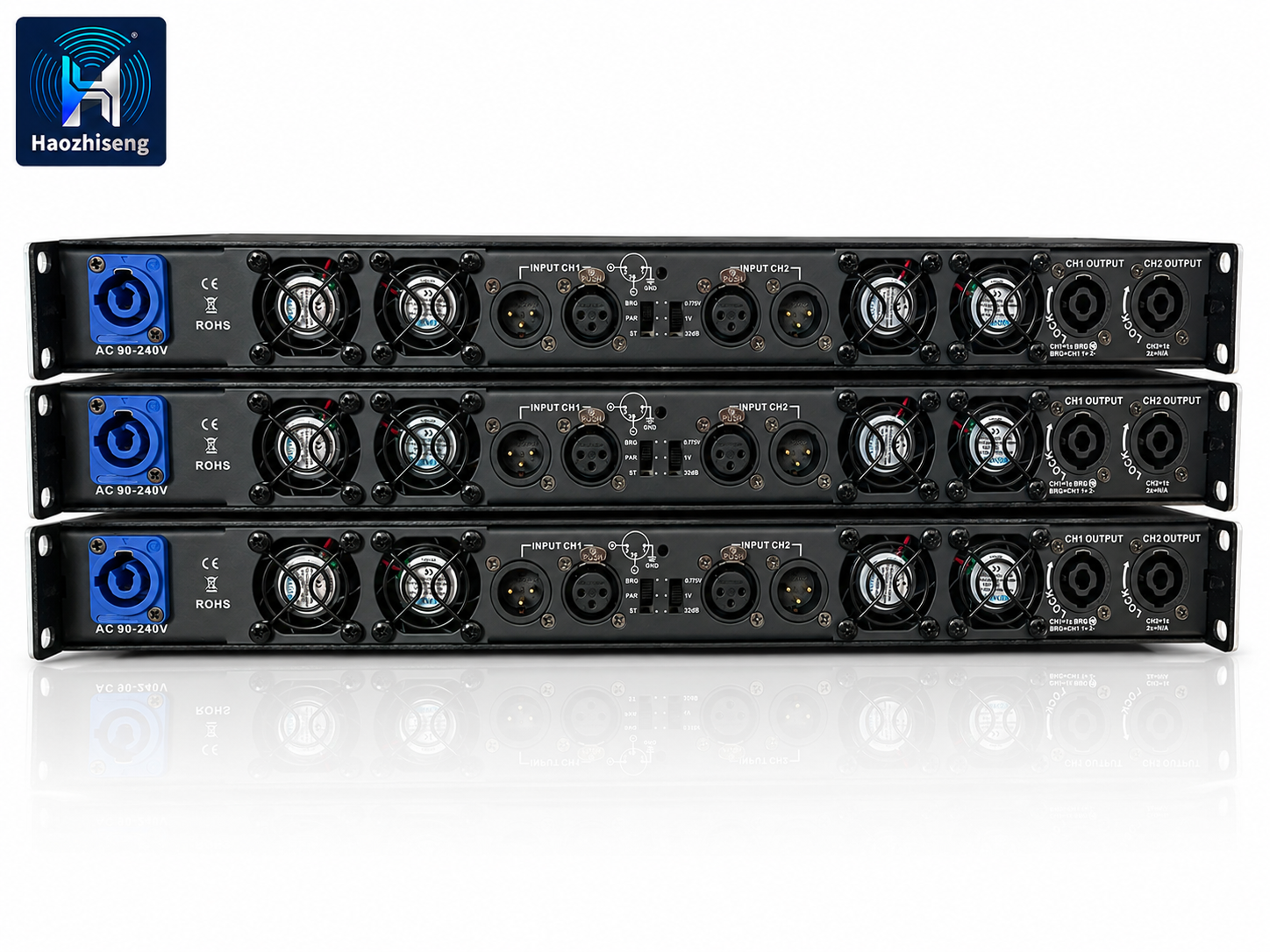
The HA2402 provides:
- 2 × 2400W at 8Ω
- 2 × 4100W at 4Ω
- 2 × 6300W at 2Ω
- Compact 1U chassis
Its two-channel format is worth evaluating for dedicated subwoofer duties where rack space is limited and the connected cabinets require substantial output.
Amplifiers with Integrated DSP and System Control
DF18K4 — Dante, FIR, and Touchscreen Operation
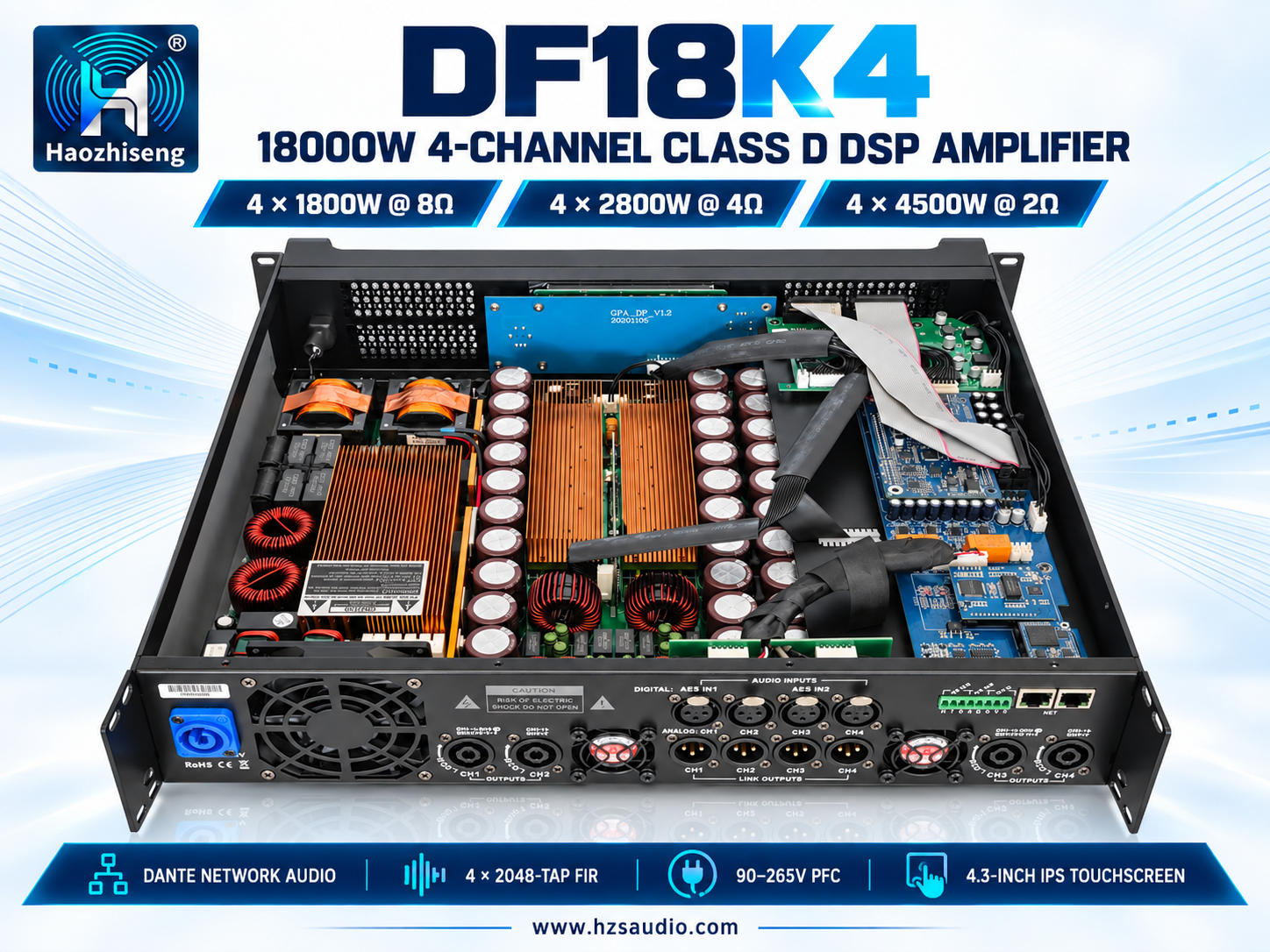
The DF18K4 combines four-channel amplification with:
- 4 × 1800W at 8Ω
- 4 × 2800W at 4Ω
- 4 × 4500W at 2Ω
- 4 × 2048-tap FIR filters
- Dante network audio
- 4.3-inch IPS touchscreen
- 90–265V PFC power supply
- 2U chassis
Consider it when your system needs network audio distribution, onboard loudspeaker processing, and direct access to settings from the front panel.
HA-DSP1804 — FIR DSP in a Space-Saving 1U Format


The HA-DSP1804 provides:
- 4 × 1800W at 8Ω
- 4 × 2800W at 4Ω
- 4 × 4500W at 2Ω
- Integrated FIR DSP
- Network functionality
- 1U rackmount design
It is an option for projects that require onboard processing and four amplifier channels while keeping rack space requirements low.
View HA-DSP1804 Product Details
HADSP10KQ — Four-Channel DSP Amplification with Ethernet Control


The HADSP10KQ combines four-channel Class-D amplification, integrated DSP, and Ethernet control.
Consider it for installations and event systems that need multiple amplifier outputs with computer-based processing control. Compare its detailed output specifications with the intended loudspeaker loads before making the final selection.
View HADSP10KQ Product Details
HAX12 PRO — DFM DSP and Ethernet Control
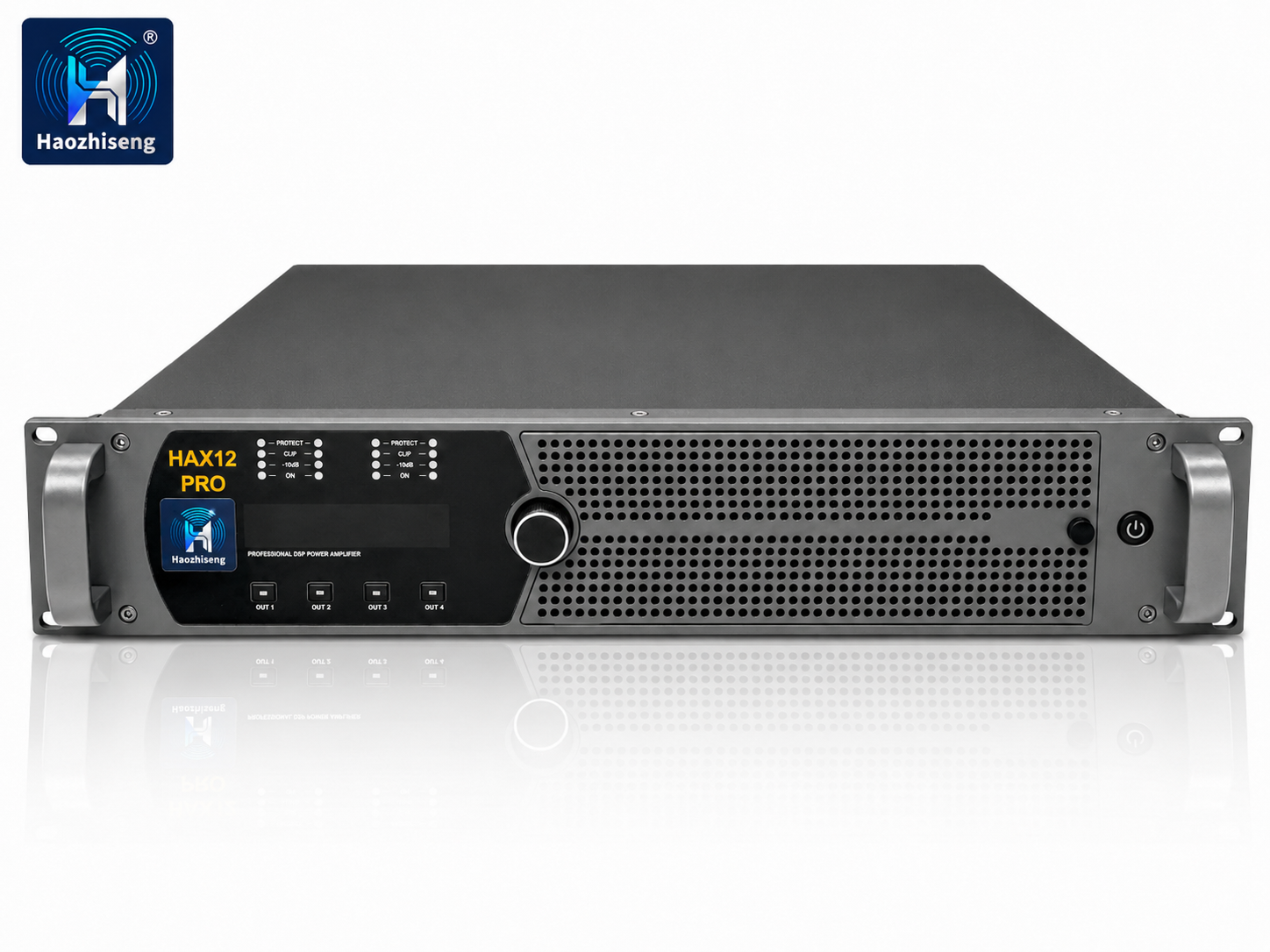

The HAX12 PRO offers:
- 4 × 1500W at 8Ω
- 4 × 2800W at 4Ω
- 4 × 3000W at 2Ω
- DFM DSP
- Ethernet control
- 100–240V power supply
It is another candidate for projects that prioritize integrated signal processing and control of multiple loudspeaker channels.
View HAX12 PRO Product Details
Amplifiers for Demanding Subwoofer Systems
HA20K — Four-Channel Power with External System Processing


The HA20K provides:
- 4 × 2100W at 8Ω
- 4 × 4000W at 4Ω
- 2 × 10000W bridged at 8Ω
It is a candidate for subwoofer systems that already use a dedicated external processor. This arrangement allows you to manage crossover, EQ, delay, and limiting centrally while assigning amplifier channels to compatible loudspeaker groups.
HA20KQ — Subwoofer Amplification with Integrated DSP


The HA20KQ offers:
- 4 × 2100W at 8Ω
- 4 × 4000W at 4Ω
- Integrated 4-input/4-output DSP
- Ethernet, RS485, and USB control
- EQ, crossover, limiter, delay, gain, polarity, and mute functions
Consider the HA20KQ when you want loudspeaker processing and amplification within one unit, with PC access for setup and adjustment.
HA43K2 — High-Output Two-Channel Subwoofer Amplification


The HA43K2 provides:
- 2 × 4300W at 8Ω
- 2 × 7900W at 4Ω
- 2 × 8600W at 2Ω
Its two-channel design is intended for demanding subwoofer applications. The platform also features SiC MOSFET technology and a PFC power supply.
Consider this model when your design calls for two high-output amplifier feeds. Match cabinet power handling, combined impedance, wiring, and limiter settings to the available output.
HA32K4 — Four Channels for Larger Subwoofer Systems

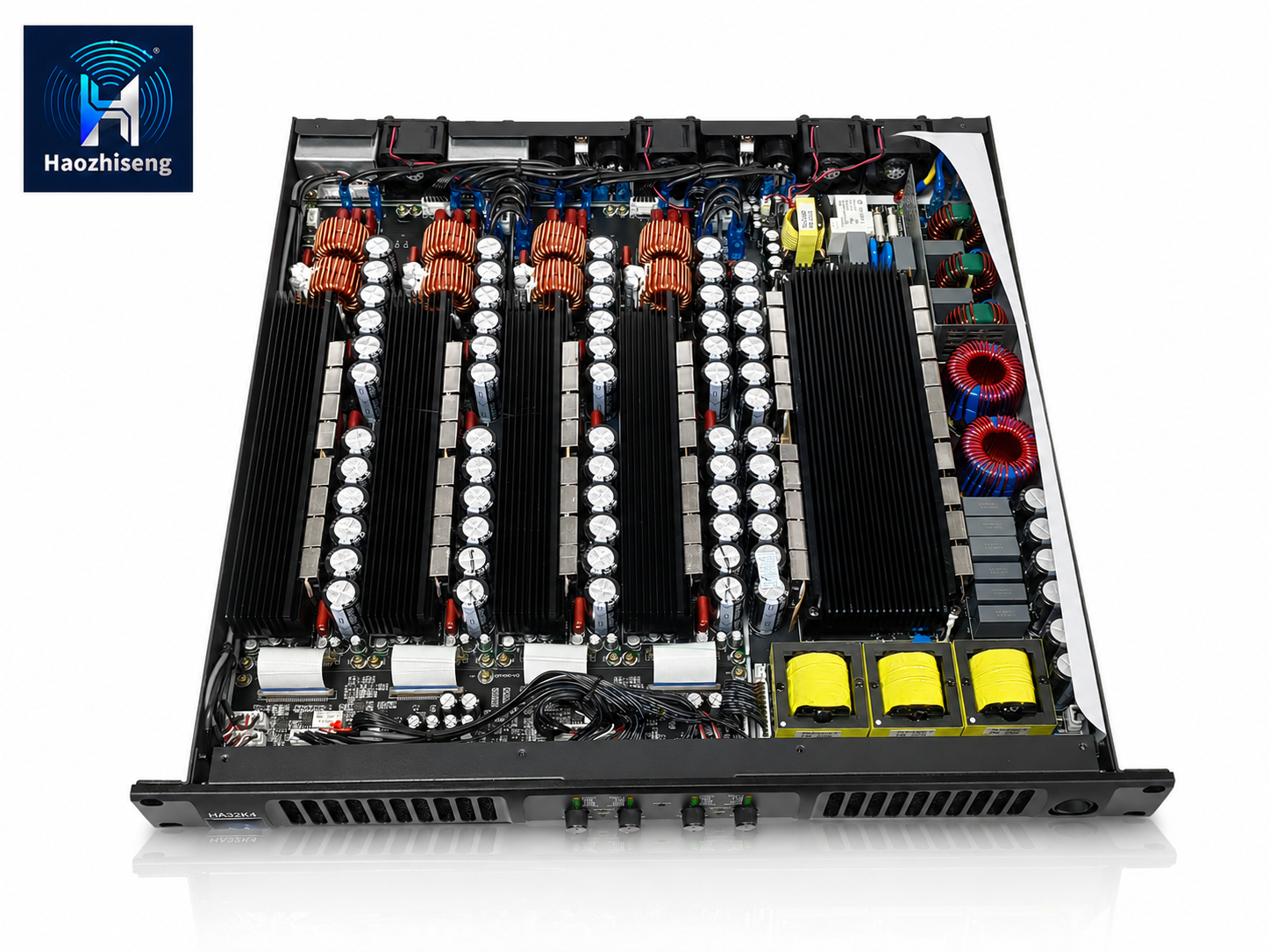
The HA32K4 lists:
- 4 × 3200W at 8Ω
- 4 × 5200W at 4Ω
- 4 × 6700W at 2Ω
- SiC MOSFET technology
- PFC power supply
Its four-channel format is a candidate for larger installations and touring racks requiring several independently driven subwoofer groups.
For low-impedance planning, distinguish the published 2Ω output rating from the separately listed 2.7Ω long-term stable-load specification. Confirm the intended loading and operating conditions with our team before finalizing the system.
12. Narrow Down Your Options
Use your system requirements to create a shortlist:
| Your Main Requirement | Models to Evaluate |
|---|---|
| Four channels in a compact 1U rack | HA1804, HA-DSP1804 |
| Two-channel subwoofer amplification | HA2402, HA43K2 |
| Four-channel subwoofer amplification | HA20K, HA20KQ, HA32K4 |
| Integrated DSP and computer control | HADSP10KQ, HAX12 PRO, HA20KQ, HA-DSP1804, DF18K4 |
| Dante and touchscreen operation | DF18K4 |
These categories help identify relevant models, but they do not establish compatibility with a particular loudspeaker.
For each candidate, check the output per channel at your intended load, available headroom, processing functions, mains requirements, and cooling provisions.
Frequently Asked Questions
Should amplifier power equal speaker power?
Not necessarily. A suitable amplifier may have additional output capacity for musical peaks. The correct relationship depends on the speaker manufacturer’s recommendations, program material, and protection settings.
Can I use a 1,000W amplifier with a 500W speaker?
Potentially, if those ratings are compared at the correct impedance and the speaker manufacturer supports that approach. The speaker must still be protected against excessive sustained power and excursion.
Can one amplifier channel drive two speakers?
Yes, when the combined load is supported. Two identical 8Ω speakers connected in parallel form a nominal 4Ω load and share the channel’s output approximately equally.
Does twice the wattage mean twice the volume?
No. Doubling electrical power produces approximately 3 dB more SPL under ideal conditions. Sensitivity, compression, excursion, and coverage all affect the real result.
Is integrated DSP worth considering?
Yes, when you want crossover, EQ, limiting, and other supported processing within the amplifier. An external processor can also be appropriate, especially when you already have an established system-control arrangement.
Find the Right Amplifier with Haozhiseng Audio
The right amplifier provides the output your system needs, supports the connected load, and works with suitable loudspeaker protection.
At Haozhiseng Audio, we help customers evaluate amplifier options for passive full-range speakers, line arrays, and subwoofers.
For configuration support, send us:
- Loudspeaker models and specifications
- Continuous power handling and nominal impedance
- Number of cabinets per channel
- Venue size and application
- Available mains voltage
- DSP and network-control requirements
Contact Haozhiseng Audio to discuss an amplifier configuration for your next installation, rental system, or live sound project.
🌐 www.hzsaudio.com
📧 [email protected]
Found this guide helpful? Share it with your sound engineer, installer, or rental team before your next system upgrade.
Leave a Reply