

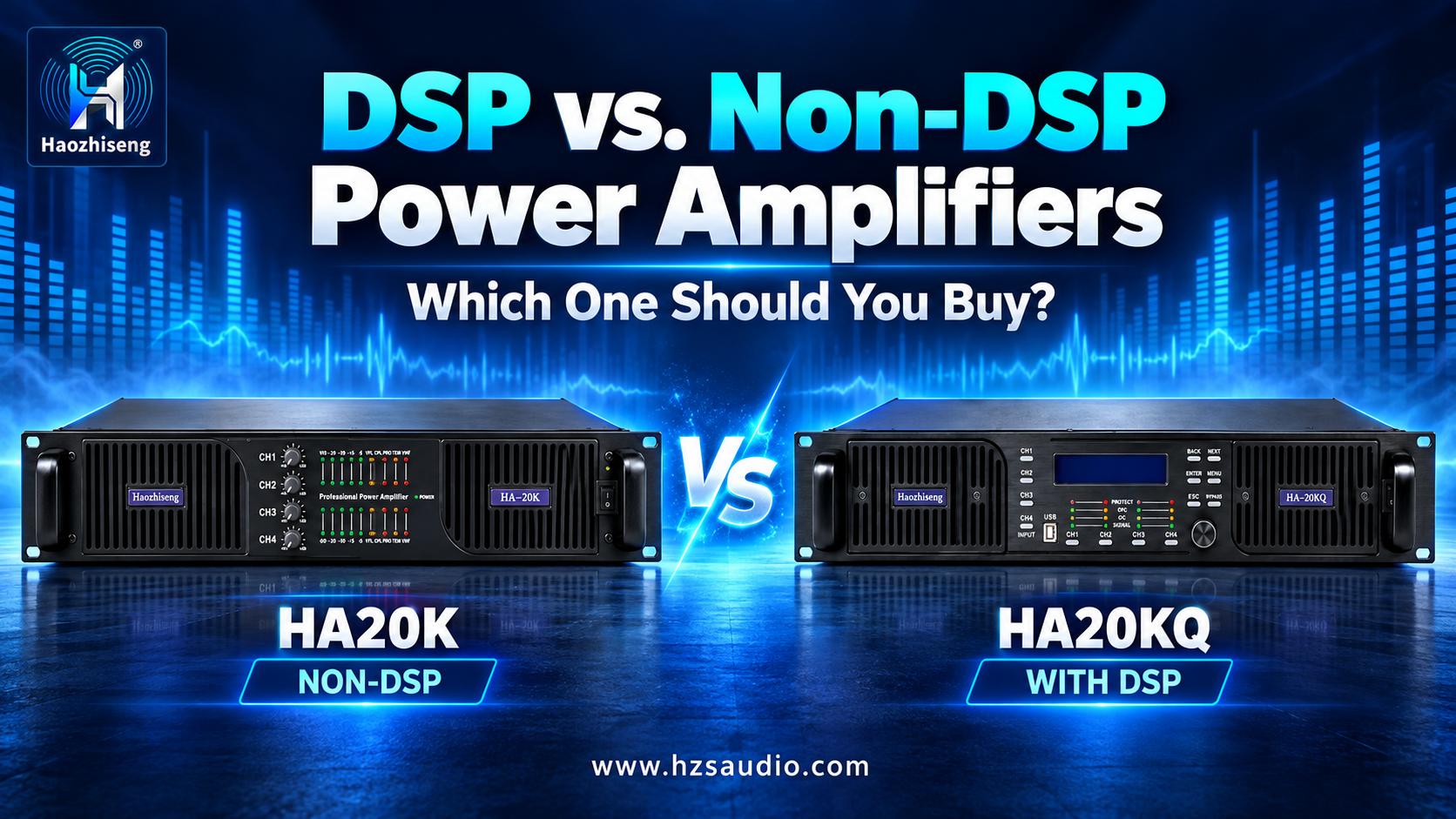
DSP vs. Non-DSP Power Amplifiers: Which One Should You Buy?
If you are buying a professional power amplifier, one question often comes up early in the selection process:
Should I choose an amplifier with built-in DSP, or is a standard non-DSP amplifier enough?
DSP power amplifiers have become increasingly popular in live sound, touring, rental systems, clubs, houses of worship, and fixed installations. They combine power amplification with loudspeaker processing and system control in one unit.
However, that does not mean a DSP amplifier is automatically the best choice for every project.
The right answer depends on your system size, loudspeaker configuration, existing equipment, control requirements, and budget. This guide explains what a DSP power amplifier does, its main advantages, when a non-DSP amplifier may be the better choice, and which Haozhiseng Audio models may fit your application.
First, a Common Misunderstanding: DSP and Class D Are Not Opposites
Customers sometimes ask whether they should buy a “DSP amplifier” or a “switching amplifier.” These terms describe different parts of the product and should not be treated as competing technologies.
- DSP describes how the audio signal is processed and controlled.
- Class D describes the amplifier’s power-output topology.
- A switch-mode power supply describes how the amplifier converts incoming AC power.
A modern professional amplifier can therefore use a Class D output stage, a switch-mode power supply, and built-in DSP at the same time.
The real buying decision is usually:
Do you need DSP integrated into the amplifier, or will you use a separate external loudspeaker processor?
What Is a DSP Power Amplifier?
DSP stands for Digital Signal Processing.
A DSP power amplifier combines a professional power amplifier with an integrated digital loudspeaker processor.
A traditional non-DSP amplifier mainly receives an audio signal, increases its power, and drives the connected loudspeakers. A DSP amplifier performs the same amplification task, but it can also process the audio signal before it reaches the power-output stage.
Depending on the model, built-in DSP may include:
- Parametric EQ
- High-pass and low-pass crossover filters
- Gain control
- Delay and time alignment
- Polarity control
- Output limiting
- Input and output routing
- Channel mixing
- Preset storage and recall
- FIR filtering
- USB, RS-485, or Ethernet control
- Network audio such as Dante
In simple terms, a DSP amplifier combines the functions of a professional power amplifier and a loudspeaker management processor in one chassis.
What Are the Main Advantages of a DSP Power Amplifier?
1. More Precise Sound-System Tuning
DSP allows the user to make accurate adjustments to different frequency ranges.
A parametric equalizer, commonly called PEQ, lets an engineer adjust specific frequencies, gain levels, and bandwidth values. This can help control harsh high frequencies, muddy low-mid frequencies, uneven bass response, or other problems within the sound system.
Compared with basic analog tone controls, DSP normally provides much more precise adjustment of frequency, gain, and Q values.
DSP does not automatically make a sound system better. Its value comes from giving the user accurate tools to optimize the amplifier and loudspeakers for the room, system design, and application.
2. Built-In Crossover Control
A DSP amplifier can provide high-pass and low-pass filters that send the correct frequency range to each loudspeaker.
For example, crossover settings can:
- Send mid and high frequencies to full-range or line-array loudspeakers
- Send low frequencies to subwoofers
- Remove frequencies that a loudspeaker cannot reproduce safely or efficiently
- Separate frequency bands in bi-amplified or multi-way systems
Correct crossover settings can improve system efficiency, increase sound clarity, and reduce unnecessary stress on loudspeaker drivers.
3. Delay and Time Alignment
In larger sound systems, the main speakers, subwoofers, front fills, side fills, and delay speakers may be positioned at different distances from the audience.
These physical distance differences can cause sound from different loudspeakers to arrive at different times.
The delay function inside a DSP amplifier can help align the arrival times of the loudspeakers. Correct time alignment can improve clarity, phase consistency, bass response, and the overall listening experience.
This function is particularly useful for:
- Line-array systems
- Large indoor venues
- Outdoor concerts
- Subwoofer alignment
- Front-fill and delay-speaker systems
- Distributed and multi-zone audio installations
4. Better Loudspeaker Protection
A DSP amplifier normally includes a limiter that can be configured according to the power rating and operating limits of the connected loudspeaker.
When the signal exceeds the configured threshold, the limiter controls the output level. This can reduce the risk of clipping, excessive power, overloading, and loudspeaker damage.
Limiter protection is particularly valuable in rental, touring, and fixed-installation systems where different operators may use the equipment.
Correct limiter settings help maintain consistent system performance and protect both the amplifier and loudspeakers during demanding operation.
5. Flexible Signal Routing and Channel Control
Built-in DSP can provide independent control of each input and output channel.
Depending on the amplifier model, available functions may include:
- Input and output gain
- Mute control
- Polarity switching
- Input and output routing
- Channel mixing
- Independent channel EQ
- Crossover settings
- Delay adjustment
- Output limiting
- Stereo, parallel, or multi-zone configurations
This flexibility allows one amplifier to be used in several types of professional sound systems, including stereo full-range systems, bi-amplified systems, subwoofer systems, stage monitors, and multi-zone installations.
6. Faster Setup with Preset Storage
Once the sound system has been tuned, the user can save the DSP parameters as a preset.
The correct configuration can then be recalled for a particular loudspeaker model, venue, or event without rebuilding every setting from the beginning.
Preset storage can help:
- Reduce setup and commissioning time
- Maintain consistent system performance
- Prevent accidental parameter changes
- Simplify operation for less-experienced users
- Manage multiple loudspeaker configurations
- Prepare different settings for different venues
This is especially useful for rental companies, touring systems, and venues that regularly change their sound-system configuration.
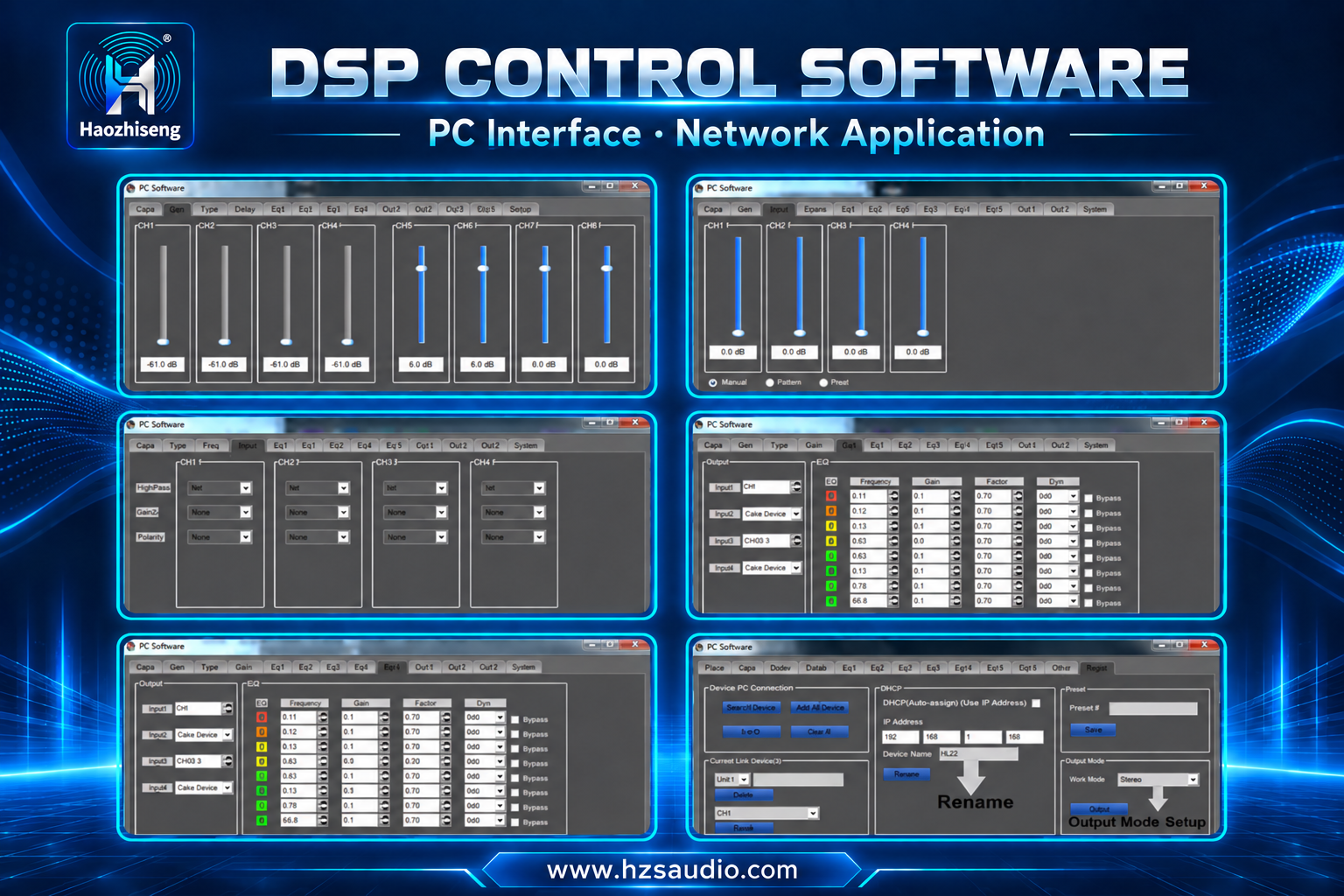
7. PC and Network Control
Many professional DSP amplifiers can be configured from a computer through USB, RS-485, or Ethernet.
Professional control software allows users to view and adjust DSP parameters from a computer instead of making every adjustment directly from the amplifier’s front panel.
Some systems also allow multiple amplifiers to be connected and managed from one PC.
Centralized amplifier control is particularly useful for:
- Touring and concert systems
- Line-array systems
- Clubs and theaters
- Stadiums and conference centers
- Houses of worship
- Fixed installations
- Multi-zone sound systems
Ethernet and Wi-Fi network access can also reduce the need to run additional control cables or make every adjustment at the amplifier rack.
8. Less External Equipment and Simpler Wiring
A conventional amplifier rack may require a separate crossover, equalizer, delay unit, limiter, or loudspeaker management processor.
A DSP power amplifier integrates many of these functions into the amplifier itself.
This can help reduce:
- The number of external rack devices
- Signal-cable connections
- Rack space and system weight
- Installation time
- Potential connection failure points
- Equipment configuration complexity
For touring and rental companies, fewer devices and cables can also make the system faster to transport, install, and troubleshoot.
Can a DSP Amplifier Save Money?
A DSP amplifier can reduce the total cost of a sound system, but the answer depends on the complete system configuration.
A DSP amplifier normally costs more than a comparable non-DSP amplifier. However, it may eliminate the need to purchase a separate loudspeaker processor and additional signal cables.
It may also reduce rack space, installation time, and system complexity.
When comparing the cost, consider:
- The price of an external DSP processor
- Additional signal and control cables
- Required rack space
- Installation and commissioning time
- Remote-control requirements
- The number of amplifiers in the system
- Whether you already own a suitable external processor
If you are building a new professional sound system, integrated DSP may offer better overall value.
If you already have a high-quality external processor and an established system-control workflow, a non-DSP amplifier may be more economical.
Does Ethernet Control Reduce Cable Problems?
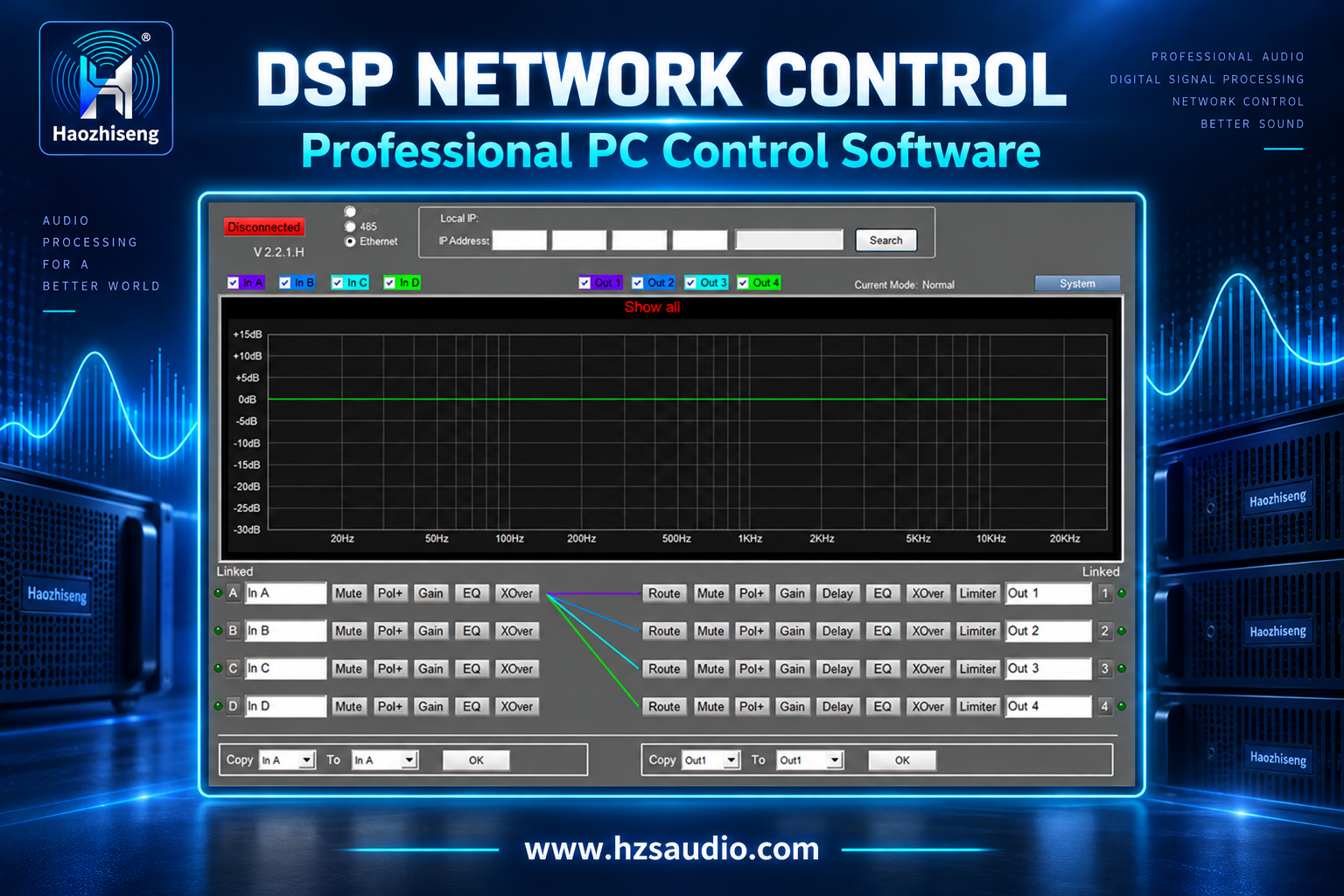
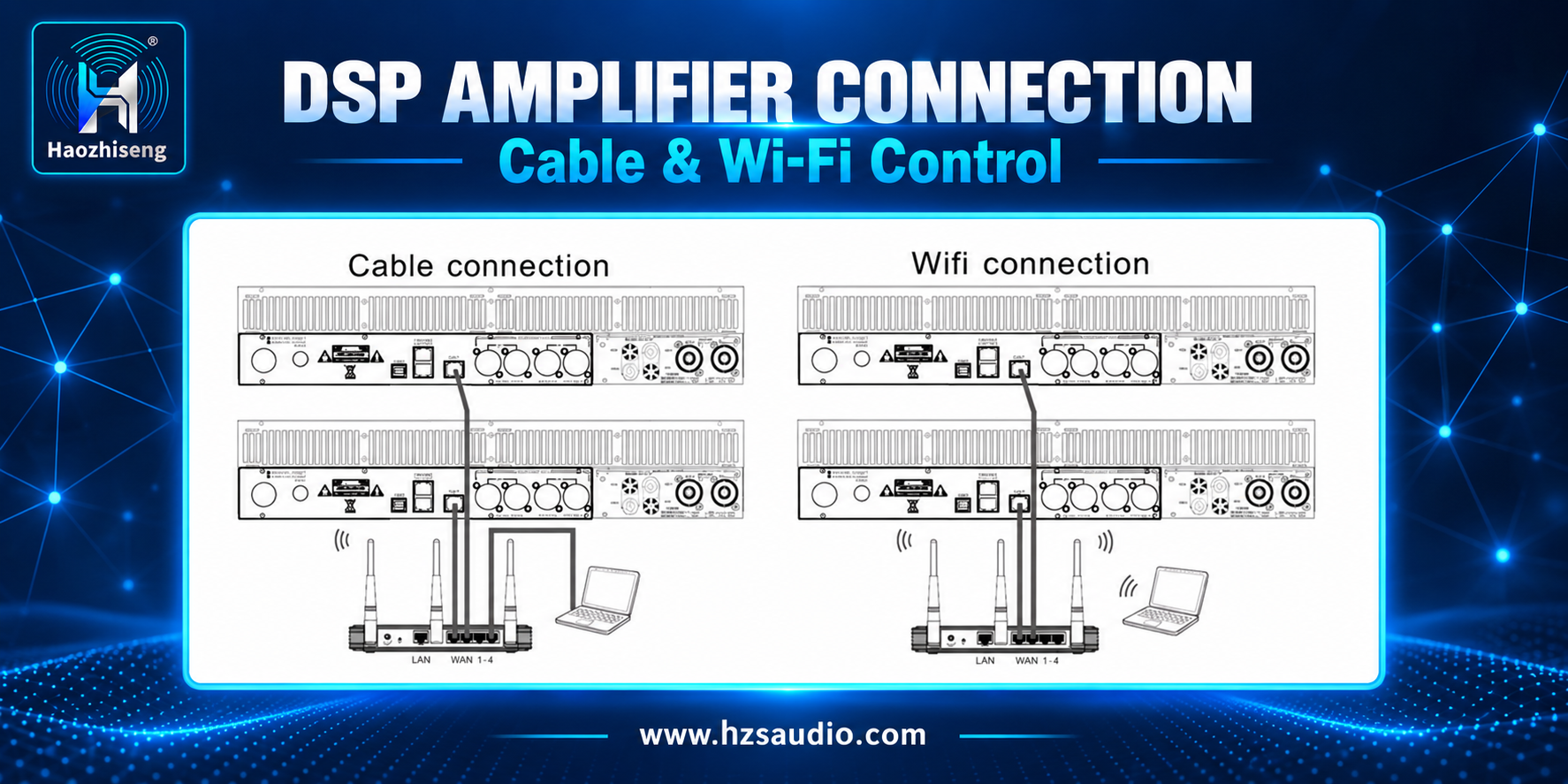
Ethernet-enabled DSP amplifiers can make it easier to manage multiple amplifiers from one computer.
When the amplifier network is connected to a Wi-Fi router, an engineer may be able to access the control system wirelessly from a laptop. This can make adjustments more convenient in large venues or installations where the amplifier rack is far away from the listening area.
Centralized Ethernet control can also simplify the control network and reduce dependence on long point-to-point control cables.
However, Ethernet control does not completely eliminate the need for good network design. A professional system should still use reliable routers, switches, cables, network addressing, and backup plans where necessary.
When Should You Choose a DSP Power Amplifier?
A DSP amplifier is usually the better option when you need:
- Precise loudspeaker tuning
- Active crossover control
- Subwoofer alignment
- Delay for fills or distributed loudspeakers
- Reliable limiter settings
- Multiple saved configurations
- Centralized PC or network control
- Fewer external rack devices
- FIR processing
- Dante or other network-audio functions
DSP amplifiers are especially useful for rental companies, touring engineers, system integrators, venues, and sound-system operators who regularly change system configurations.
When Is a Non-DSP Amplifier the Better Choice?
A standard non-DSP amplifier may be the more practical option when:
- The sound system is simple
- Advanced signal processing is not required
- A separate professional DSP processor is already installed
- One central processor controls amplifiers from different manufacturers
- The operator prefers a familiar external processing workflow
- The project prioritizes a lower initial amplifier cost
- The amplifier is being purchased as a direct replacement in an existing system
A non-DSP amplifier is not an outdated choice.
When used with a correctly configured external loudspeaker processor, it can deliver excellent performance and may provide greater flexibility in complex systems built around centralized signal processing.
DSP vs. Non-DSP Power Amplifiers: Quick Comparison
| Feature | DSP Power Amplifier | Non-DSP Power Amplifier |
|---|---|---|
| Power amplification | Yes | Yes |
| EQ and crossover | Built in | Requires external processing |
| Delay and time alignment | Built in | Requires external processing |
| Limiter and speaker presets | Usually built in | Depends on external equipment |
| PC or network control | Available on supported models | Usually limited or unavailable |
| External equipment | Fewer external devices required | May require a separate processor |
| Rack space | More functions in one chassis | Additional rack space may be required |
| Initial amplifier cost | Usually higher | Usually lower |
| Best suited for | Integrated and remotely managed systems | Simple systems or systems with external DSP |
Recommended Haozhiseng Audio DSP Power Amplifiers
Haozhiseng Audio offers DSP power amplifiers for applications ranging from compact full-range systems to high-output subwoofer systems, touring racks, and Dante network-audio installations.
HA20KQ 20000W 4-Channel Class D DSP Subwoofer Power Amplifier
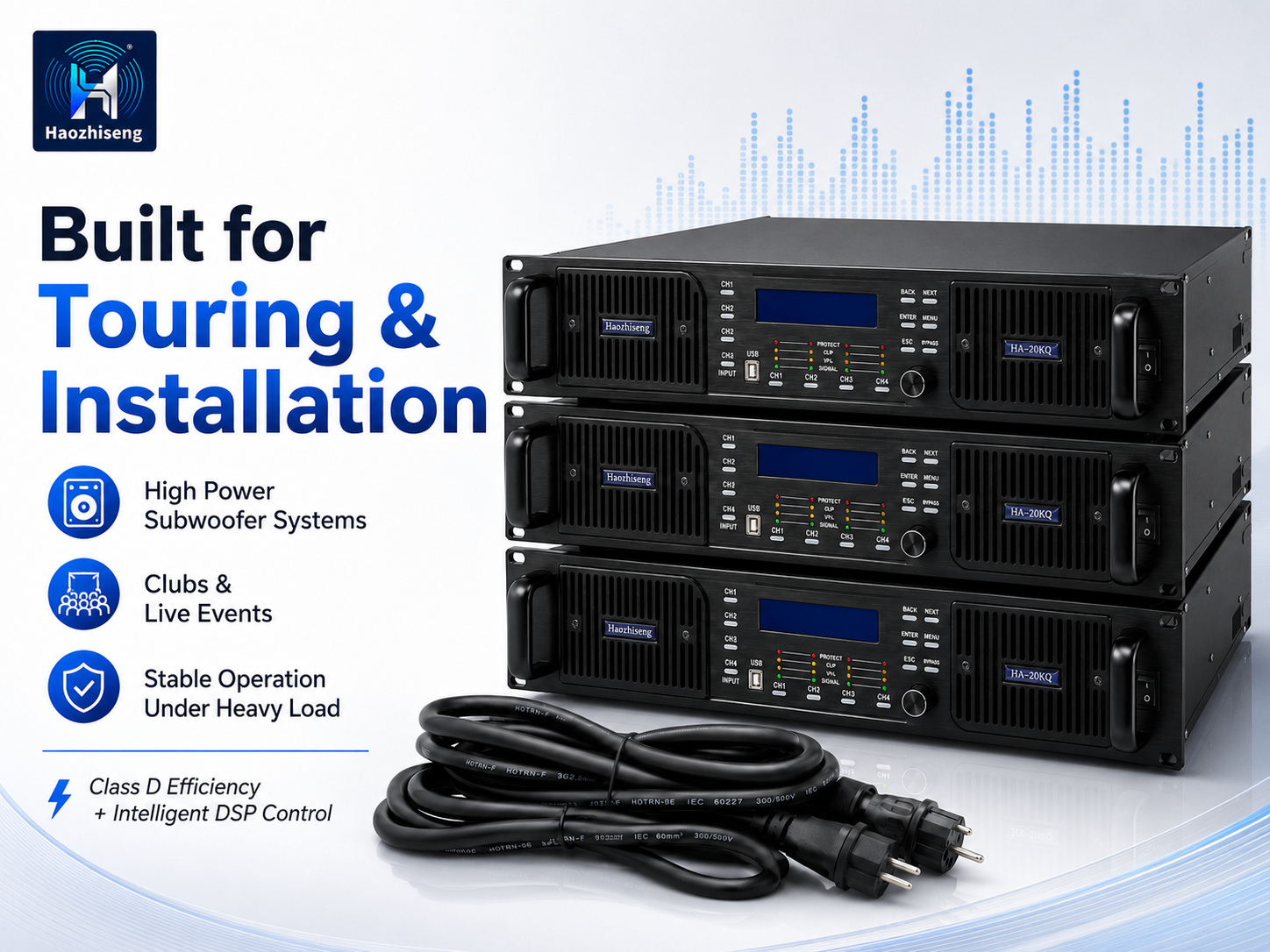
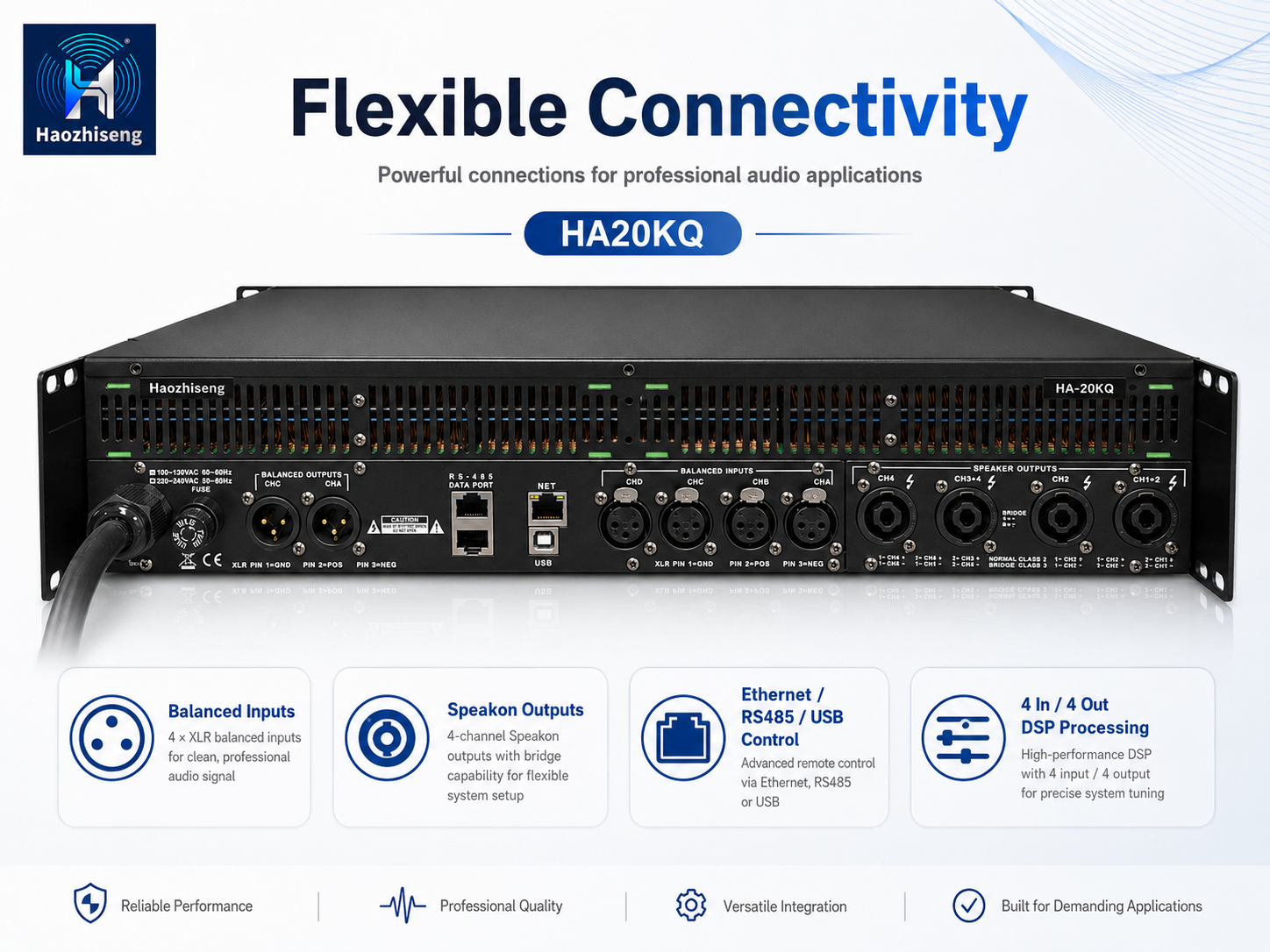
The HA20KQ is designed for professional high-output subwoofer systems.
It combines powerful four-channel Class D amplification with 4-input/4-output DSP processing and Ethernet, RS-485, and USB control.
Key DSP functions include:
- EQ
- Crossover
- Delay
- Limiter
- Gain
- Mute
- Polarity control
- Input and output routing
- Preset storage and recall
The HA20KQ is a strong choice for touring PA systems, clubs, stadiums, outdoor events, and fixed installations that require powerful bass output with centralized digital control.
Learn more:
HA-DSP10KQ 10000W 4-Channel Class D DSP Power Amplifier
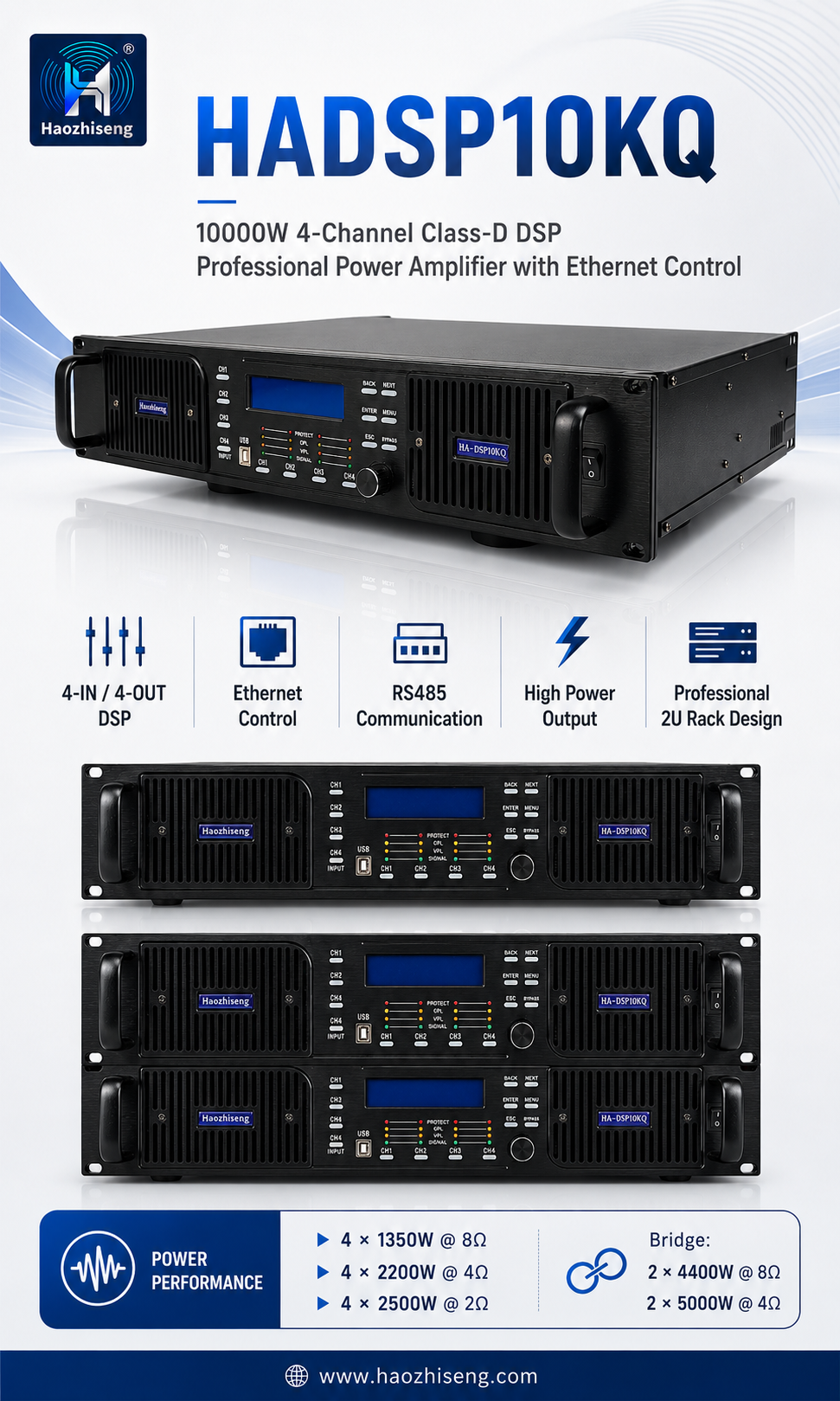
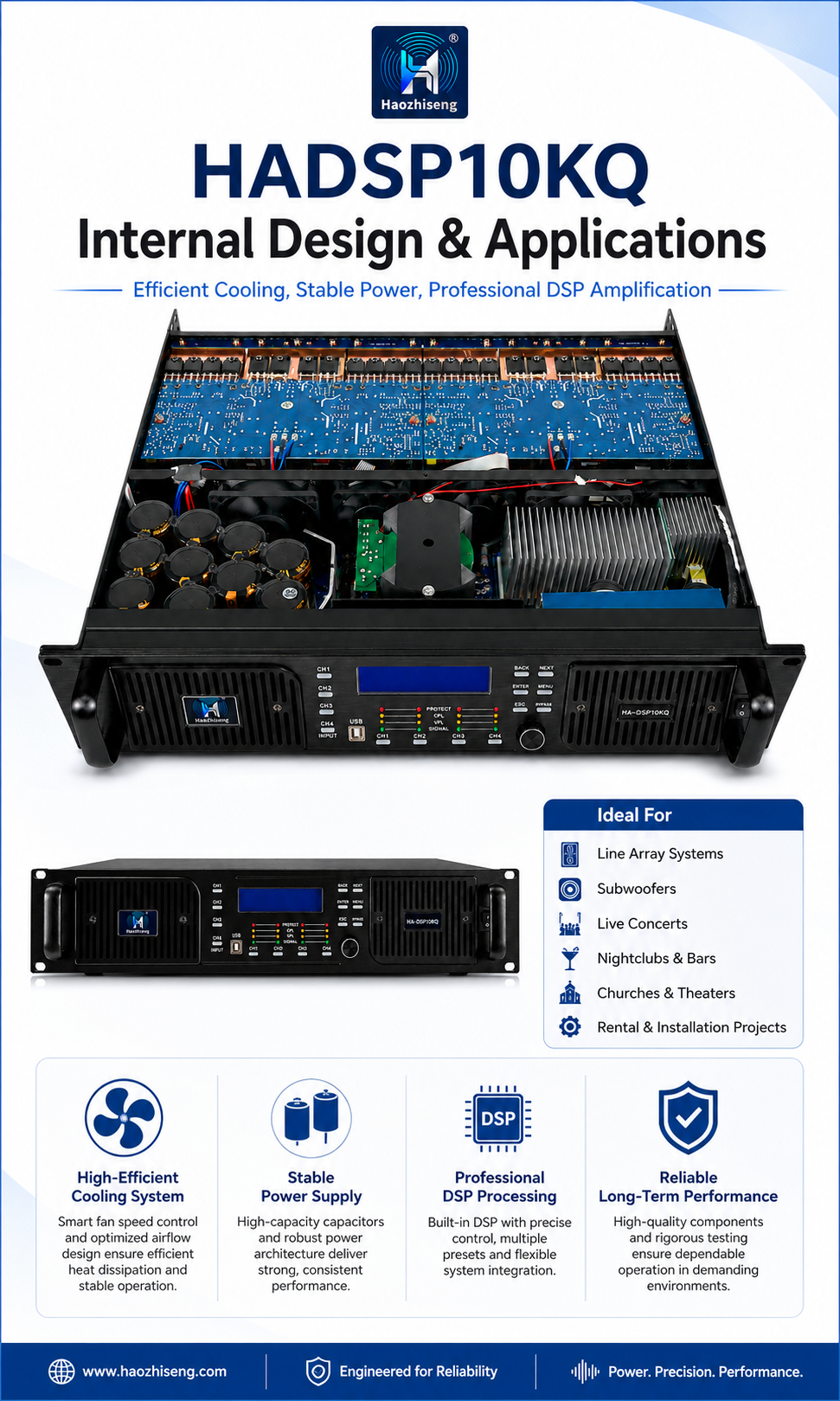
The HA-DSP10KQ is a versatile four-channel DSP power amplifier for professional PA applications.
It is suitable for users who want loudspeaker processing, preset management, and Ethernet control integrated into one professional amplifier platform.
The HA-DSP10KQ is suitable for:
- Full-range PA systems
- Stage sound systems
- Rental amplifier racks
- Clubs and entertainment venues
- Fixed installations
- Small and medium-sized touring systems
Learn more:
HA5004SD 3600W 4-Channel Class D DSP Power Amplifier


The HA5004SD delivers:
- 4 × 500W at 8Ω
- 4 × 900W at 4Ω
Its compact 1U chassis makes it suitable for full-range loudspeakers, stage monitors, and multi-zone sound systems.
The built-in 4-input/4-output DSP supports crossover, parametric EQ, delay, limiter, and preset storage. USB and RS-485 control provide convenient computer-based system setup.
Learn more:
HAX12 PRO 12000W 4-Channel Class D DSP Power Amplifier


The HAX12 PRO is designed for professional users who require high-output four-channel amplification, integrated DSP, and flexible computer control.
It is suitable for:
- Touring systems
- Rental sound companies
- Line-array systems
- Live events
- Clubs and theaters
- Fixed installations
Learn more:
HA-DSP1804 18000W 4-Channel 1U Class D Power Amplifier


The HA-DSP1804 combines high output power, advanced FIR processing, network-audio control, and a compact 1U rack design.
Its DSP functions include:
- Mute
- Polarity
- Gain
- Delay
- Limiter
- Mixer
- FIR filtering
- Parametric EQ
- All-pass filters
- Crossover control
The amplifier supports four 2048-tap FIR filters for advanced loudspeaker frequency and phase correction.
The HA-DSP1804 is suitable for touring systems, professional AV installations, line arrays, subwoofers, and fixed sound systems where high power density and advanced processing are required.
Learn more:
DF18K4 18000W 4-Channel Class D DSP Power Amplifier
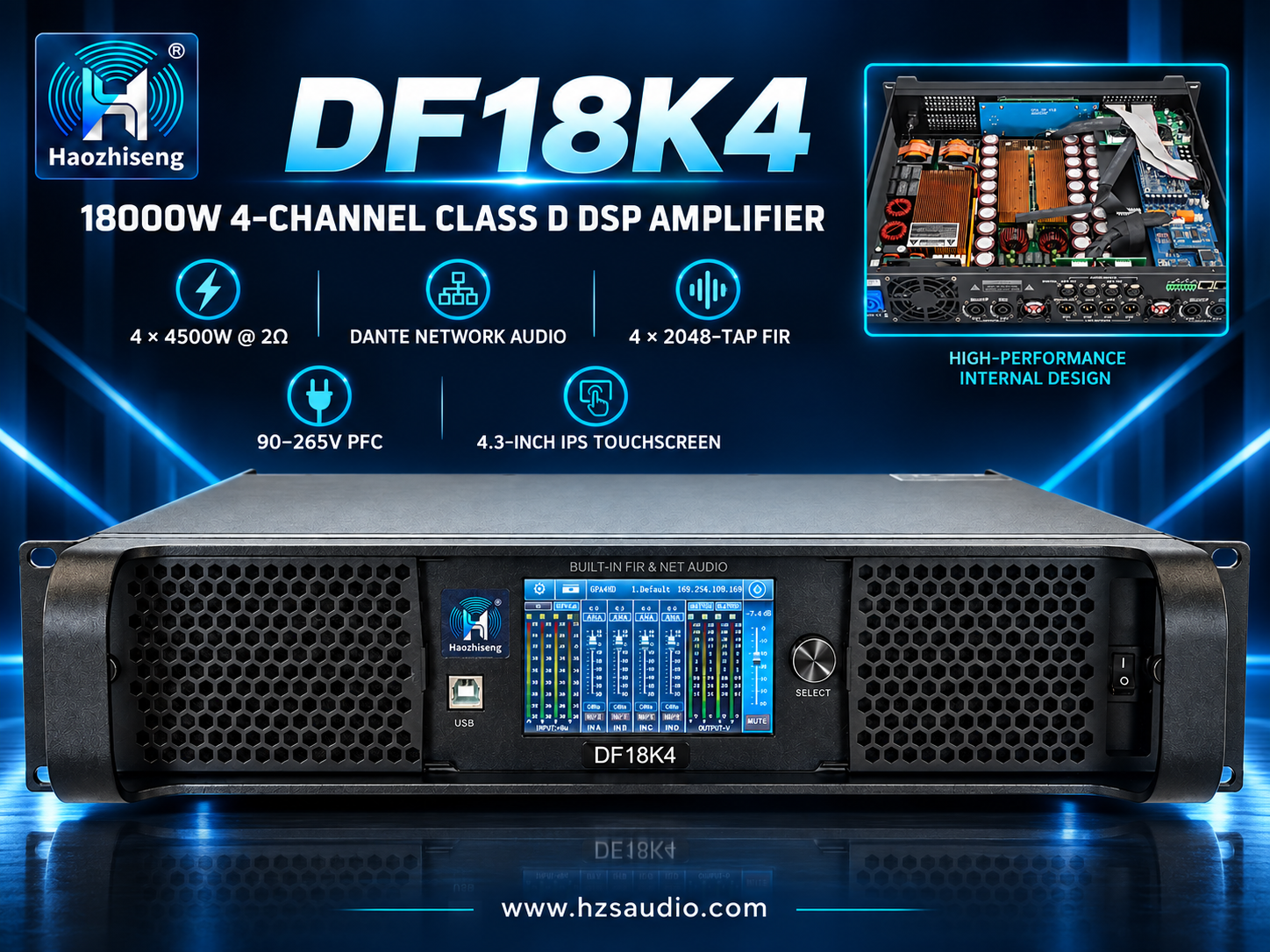
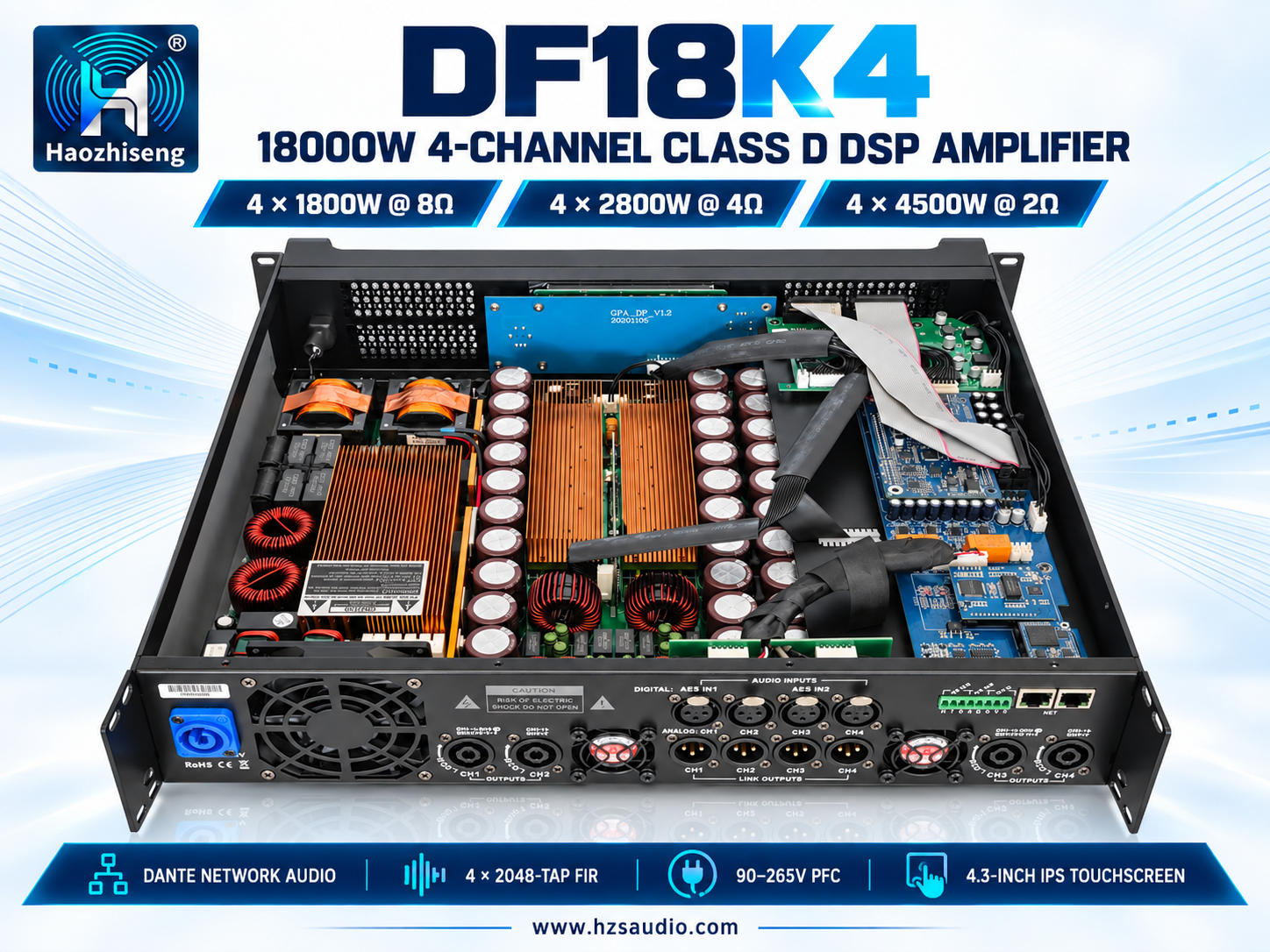
The DF18K4 is designed for demanding professional sound systems that require high power, advanced processing, network audio, and direct front-panel control.
Key features include:
- Up to 18,000W combined output
- Four-channel Class D amplification
- Stable 2Ω operation
- Dante network audio
- Four 2048-tap FIR filters
- PEQ, crossover, delay, limiter, mixer, and routing
- 4.3-inch IPS touchscreen
- USB and network DSP control
- 90–265V AC wide-voltage PFC power supply
- Comprehensive amplifier and loudspeaker protection
The DF18K4 is ideal for line arrays, high-output subwoofers, touring systems, rental applications, and fixed installations.
Learn more:
Final Answer: Do You Need a DSP Amplifier?
Choose a DSP power amplifier if you want signal processing, loudspeaker protection, presets, and system control integrated into one device.
A DSP amplifier can simplify your equipment rack, speed up setup, reduce external wiring, and provide more precise control of your loudspeakers.
Choose a non-DSP power amplifier if your system is straightforward or already uses a dedicated external loudspeaker processor.
A non-DSP amplifier can be a reliable and cost-effective solution when you do not want to duplicate processing equipment that you already own.
The most important question is not whether DSP is better in every situation.
The real question is:
Will integrated DSP make your sound system easier to tune, safer to operate, and more efficient to manage?
Need Help Choosing the Right Power Amplifier?
Tell Haozhiseng Audio about your loudspeaker models, impedance, required channel count, application, and control requirements.
Our team can recommend a suitable DSP or non-DSP power amplifier for your professional sound system.
Explore our professional power amplifiers:
https://hzsaudio.com/product_category/power-amplifier/
Website: https://www.hzsaudio.com
Email: [email protected]
WhatsApp: +86 191 9552 6661
If this guide was helpful, please share it with other audio professionals, system integrators, rental companies, and sound engineers who may be deciding between a DSP and non-DSP power amplifier.
Leave a Reply